Honoring the Next Generation of Innovators: 2025 Wei Family Private Foundation Fellowship Awards
EE honors the 2025 Wei Family Foundation Fellows and celebrates a lasting partnership supporting innovation, education, and research excellence.
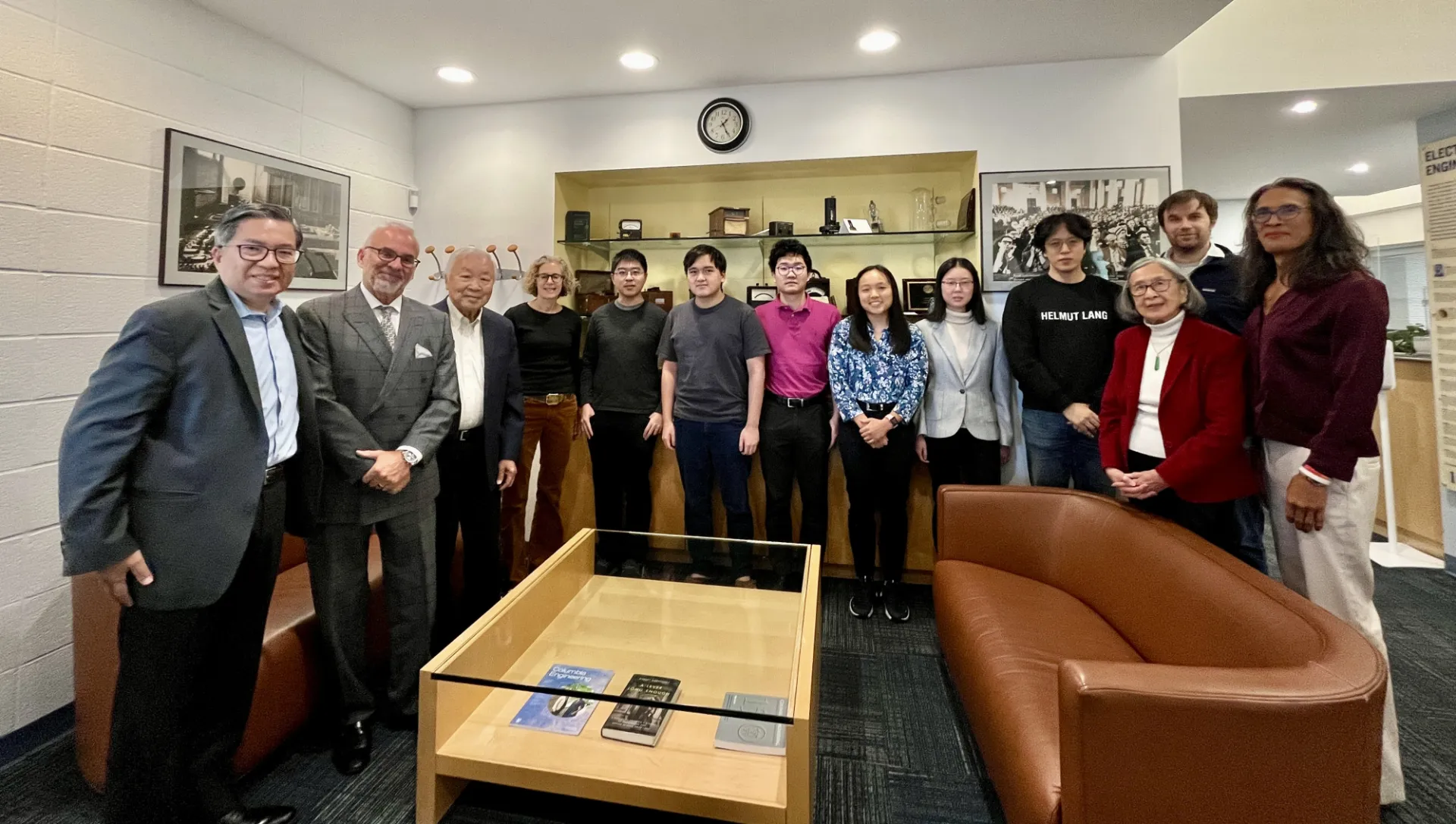
On November 6, the Columbia Electrical Engineering Department welcomed executives from the Wei Family Foundation for the annual fellowship celebration. The visit brought together current and past Wei Fellows, Columbia Engineering Dean Shih-Fu Chang—the Morris A. and Alma Schapiro Professor of Electrical Engineering—as well as EE faculty and staff, to honor the foundation’s enduring support of student research and innovation. The event featured presentations by current and past Wei Fellows, including Zichen Qian, Isabel Song, Jian Teng Yan, Arthur Dell Yang, and Xilin Jiang, who shared their groundbreaking work spanning photonics, bioelectronics, and intelligent computing systems.
Two Ph.D. students—Zichen Qian (advised by Associate Professor of Electrical Engineering Mingoo Seok) and Isabel Song (advised by Charles Batchelor Professor of Electrical Engineering Keren Bergman) —have been named 2025 Wei Family Foundation Fellows, recognized for their outstanding research, academic excellence, and potential to advance technology for the greater good. Established by Columbia Engineering alumnus Dr. Hsin Hsu Wei, the fellowship continues to foster innovation and leadership among emerging engineers, empowering students whose work bridges theory, experimentation, and real-world impact.
Designing Analog Intelligence: Zichen Qian
Zichen Qian, a first-year Ph.D. student in Associate Professor Mingoo Seok’s group, explores analog in-memory computing architectures using novel devices such as memcapacitors to accelerate deep neural networks. By combining compact circuit design with energy-efficient analog computation, Qian’s work contributes to hardware solutions that reduce power consumption in next-generation AI systems. A Columbia EE alum (B.S. and M.S. ’24), she continues to build on his undergraduate research in neuromorphic computing.
Building Scalable Optical Networks: Isabel Song
Isabel Song, a first-year Ph.D. student in Charles Batchelor Professor of Electrical Engineering Keren Bergman’s Lightwave Research Laboratory, investigates the intersection of photonics and AI. Her research examines how energy-efficient, high-bandwidth optical interconnects can address data bottlenecks in large-scale AI models. With prior experience at MIT Lincoln Laboratory and a B.S. from the University of Pennsylvania, Song’s work aims to co-design silicon photonics and computing systems that sustain the exponential growth of AI workloads.
Engineering Bioelectronic Therapeutics: Jian Teng Yan
Working under Lau Family Professor of Electrical Engineering Kenneth Shepard, Jian Teng Yan leads the BIOSYNC project, developing implantable devices that combine biological and electronic components to deliver therapeutic molecules on demand. By integrating custom ASICs for electrical stimulation, optical control, and wireless communication, Yan’s research envisions a “living pharmacy” capable of autonomously managing chronic diseases. His approach represents a pioneering step toward precision medicine through bioelectronic systems.
Teaching Machines to Listen: Xilin Jiang
A fourth-year Ph.D. student advised by Associate Professor of Electrical Engineering Nima Mesgarani, Xilin Jiang advances the field of machine listening—teaching AI to interpret sounds as humans do. His recent project, Sci-Phi, introduces a spatial audio large language model that integrates multimodal understanding across acoustic, textual, and spatial dimensions. Recognized with the Best Paper Award at WASPAA 2025, Jiang’s cross-modal AI research bridges the gap between human perception and artificial intelligence.
Advancing Biomedical Circuits: Arthur Yang
A second-year Ph.D. student in Professor Shepard’s group, Arthur Yang focuses on analog and RF integrated circuit design for biomedical applications. His work explores next-generation wireless and implantable systems, including a 60 GHz On/Off-Keying transceiver fabricated in GlobalFoundries 22nm FD-SOI and a BIOSYNC transmitter enabling energy-efficient wireless communication for biosensing. A recipient of the 2025 NSF Graduate Research Fellowship, Yang aims to make low-power electronics central to future health-monitoring technologies.
About the Fellowship
The Wei Family Private Foundation Fellowship supports Columbia EE students who demonstrate creativity, technical excellence, and a passion for discovery. Each fellow embodies Dr. Wei’s vision of empowering young scholars to pursue groundbreaking research while upholding the values of curiosity, perseverance, and public service.