Keren Bergman was named to HPCWire's 35 Legends of Class of 2026
EE Professor Keren Bergman was named to HPCWire's 35 Legends of Class of 2026 under Visionary for the Future of Photonic Computing.
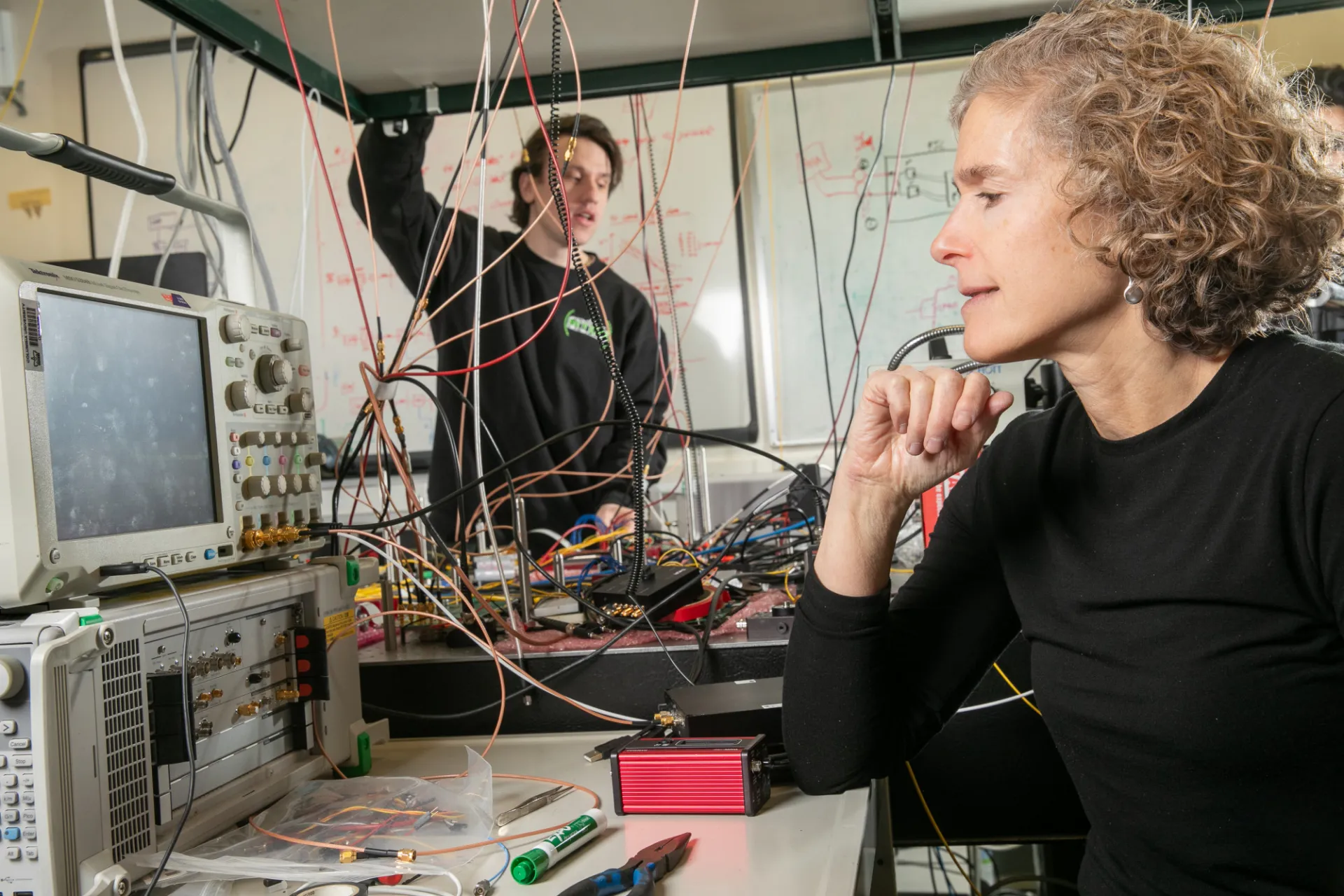
As supercomputers have grown ever more powerful, moving data efficiently has become one of the greatest challenges in high-performance computing. Few researchers have done more to address that challenge than Keren Bergman, whose pioneering work in optical interconnects is helping to redefine how future supercomputers will communicate.
For decades, advances in processor performance outpaced improvements in data movement, creating bottlenecks that increasingly limited system scalability. Bergman recognized that overcoming these limitations would require a fundamental shift away from conventional electrical communication over copper toward integrated photonic technologies capable of moving massive amounts of information faster and with lower power consumption.
Bergman’s groundbreaking research at the intersection of photonics and computing has helped to chart a new path forward for future HPC architectures. As a leader of multidisciplinary research spanning silicon photonic devices, dense wavelength-division multiplexed links, optical switches, advanced packaging, network architecture, and system-level performance modeling, Bergman’s work promises to significantly reduce energy consumption while enabling the bandwidth required for exascale computing, AI training, and data-intensive scientific applications.
Bergman was initially drawn to HPC as the logical intersection of technology, architecture, software, and applications, but her work with photonics has introduced a fundamentally different set of physical capabilities. Whereas computing systems have traditionally been designed around a steep bandwidth hierarchy, photonics offers the possibility of providing much greater bandwidth across the system at low energy per bit, opening up the possibility of creating entirely new architectures and algorithms, including flexible optical switching and dynamically reconfigurable connectivity.
A formative experience early in Bergman’s career was participating in the Hybrid Technology Multi-Threaded (HTMT) architecture project, an extraordinarily ambitious effort that brought together emerging technologies, including superconducting processors and optical networks, with innovative architectures and algorithms to explore new frontiers in supercomputing. Through that project, she had the opportunity to work with some of the leading thinkers in HPC, including several individuals who have since been recognized as HPCwire Legends. It showed Bergman that a disruptive technology has its greatest impact when it is considered as part of a complete computing system. From that point forward, she was inspired not simply to develop photonic devices, but to understand how optics could transform the architecture and performance of HPC systems
Beyond her considerable technical achievements, Bergman has played a central role in fostering collaboration among academia, government laboratories, and industry, helping accelerate the transition of photonics research into practical computing technologies. She has been an enthusiastic participant with the HPC community throughout her career through conferences, technical committees, workshops, advisory activities, and research collaborations, including SC and ISC, which have been particularly important to her. She has served in a variety of roles at both conferences, examples of leadership that has advanced not only the science of optical systems, but also the broader vision of sustainable, scalable computing.
Bergman currently is the Charles Batchelor Professor of Electrical Engineering at Columbia University, where she direct the Lightwave Research Laboratory and serves as Faculty Director of the Columbia Nano Initiative. She also directs the SRC/DARPA Center for Ubiquitous Connectivity, or CUbiC, a multi-university research center developing new technologies and architectures for energy-efficient connectivity from the edge to the cloud.
As AI models grow larger and scientific simulations generate unprecedented volumes of data, efficient communication has become just as important as computational speed. The technologies Bergman has championed are increasingly viewed as essential components of tomorrow’s computing infrastructure.
For helping illuminate one of the most promising paths toward future supercomputing architectures, Keren Bergman has become one of the leading innovators shaping the next era of high-performance computing.
Read more here.