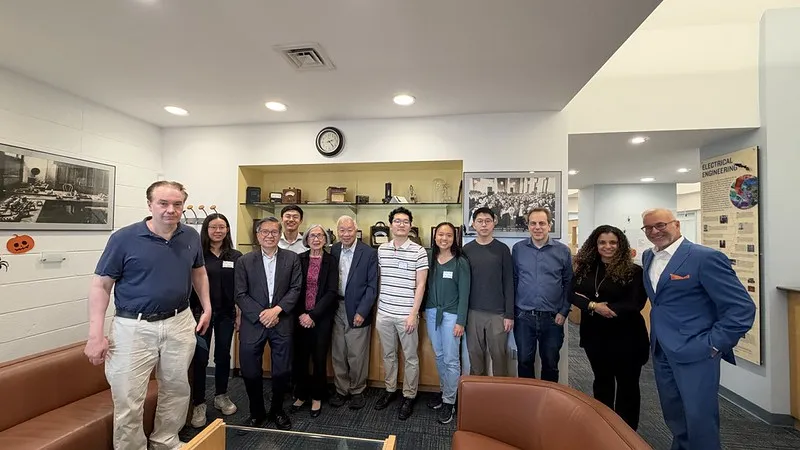
On November 5, 2026, Columbia University’s Department of Electrical Engineering welcomed leaders from the Wei Family Private Foundation for its annual fellowship luncheon, celebrating the achievements and research progress of five doctoral students supported by the foundation.
The gathering brought together fellowship recipients, faculty advisors, and foundation representatives, offering students an opportunity to share their latest research, discuss their academic journeys, and exchange ideas about the future of engineering and technology.
Through its continued support of graduate education at Columbia Engineering, the Wei Family Private Foundation helps emerging researchers pursue innovative research across electrical engineering and explore solutions to challenges in computing, communications, and healthcare.
Expanding Optical Communication Capacity: Godwin Duan
A first-year M.S./Ph.D. student advised by Charles Batchelor Professor of Electrical Engineering Keren Bergman, Godwin Duan explores silicon photonics and optical communication systems. His research interests include mode-division multiplexing, a technique that enables multiple independent signals to travel at the same wavelength, increasing communication bandwidth. Duan, who earned his undergraduate degree in electrical and computer engineering from Princeton University in 2026, is also exploring the development of more compact optical transceivers.
Designing Energy-Efficient Computing Systems: Zichen Qian
A second-year Ph.D. student advised by Associate Professor of Electrical Engineering Mingoo Seok, Zichen Qian investigates analog computing architectures for energy-efficient artificial intelligence. Her latest research compares voltage-based and time-domain approaches to transmitting analog signals across processors, examining how circuit design can improve transmission speed and energy efficiency. Qian also developed a computational tool to help researchers evaluate and optimize analog interconnect designs.
Improving the Reliability of Optical Systems: Isabel Song
A second-year Ph.D. student in Bergman’s Lightwave Research Laboratory, Isabel Song focuses on co-packaged optical systems and optical processing. Her latest research addresses the thermal sensitivity of optical modulators, a challenge that can compromise signal quality and data transmission. By developing electronic feedback systems that compensate for temperature fluctuations, Song aims to improve the reliability of high-speed optical communications for next-generation computing infrastructure.
Developing Implantable Therapeutic Technologies: Jian Teng Yan
Working under Lau Family Professor of Electrical Engineering Kenneth Shepard, Jian Teng Yan continues to advance BIOSYNC, a research project developing implantable bioelectronic devices for on-demand drug delivery. His presentation highlighted the development of custom integrated circuits that combine electrical stimulation, optical control, and therapeutic concentration monitoring. Designed to function as an implantable living pharmacy, the technology could offer new approaches to chronic disease management while addressing challenges associated with medication adherence.
Teaching Machines to Listen and Speak: Xilin Jiang
A fifth-year Ph.D. student advised by Professor Nima Mesgarani in the Neural Acoustic Processing Lab, Xilin Jiang investigates how artificial intelligence can better understand and participate in human conversations. His latest project, Cocktail-Talker, enables AI systems to determine when to respond or remain silent in noisy, multi-speaker environments, achieving approximately 93 percent accuracy in simulated tests.
Jiang also presented research conducted in collaboration with Meta Superintelligence Labs that uses human listener feedback to help AI evaluate emotional expression, warmth, and confidence in spoken conversations. Together, these projects aim to make human-machine communication more natural and responsive.
Following the presentations, foundation representatives, students, and faculty advisors participated in an extended Q&A session, providing an opportunity to discuss research developments, technical challenges, and future directions.