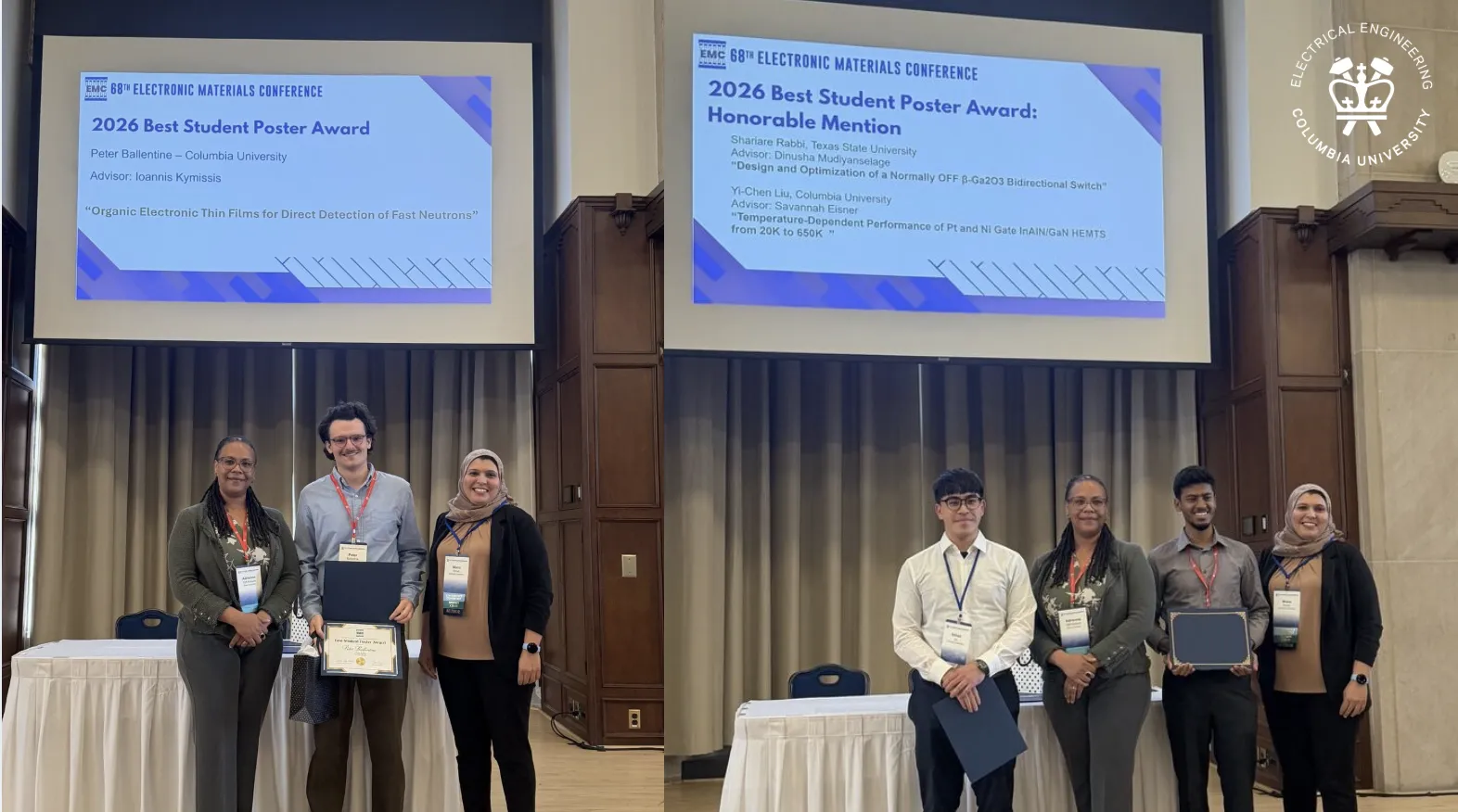
Two Columbia University Electrical Engineering Ph.D. students received top honors at the Electronic Materials Conference’s Best Student Poster Award session for research spanning extreme-temperature electronics and radiation detection.
Yi-Chen “Ethan” Liu, a Ph.D. candidate in Professor Savannah Eisner’s ETHER Lab, received an honorable mention for the Best Student Poster Award. Peter Ballentine, a fourth-year Ph.D. student in Professor Ioannis Kymissis’ Columbia Laboratory for Unconventional Electronics (CLUE), won the Best Student Poster Award.
“Almost a Columbia University sweep at the Electronic Materials Conference Best Student Poster Award Session! 2/3 ain’t bad,” Eisner wrote in announcing the honors on LinkedIn.
Liu was recognized for his research characterizing lattice-matched InAlN/GaN high-electron-mobility transistors, or HEMTs, across temperatures ranging from 20 kelvins to 675 kelvins and using various gate metallizations.
His research focuses on the design, fabrication and characterization of gallium nitride-based HEMTs for high-temperature radio-frequency applications. More broadly, Liu studies wide-bandgap semiconductors, heterogeneous integration, RF and millimeter-wave electronics, semiconductor reliability, and emerging device technologies designed to operate in extreme environments.
Before beginning his doctoral studies, Liu earned a Master of Science in materials science and engineering from Columbia, a Master of Science in chemical engineering from National Tsing Hua University and a Bachelor of Science in chemical engineering from National Chung Cheng University in Taiwan.
Ballentine received the Best Student Poster Award for his work developing fast-neutron detectors using organic electronic thin films. His research in CLUE focuses on thin-film electronics for sensing applications, including tactile sensors for robotics and direct-conversion radiation detectors made from organic semiconductor materials. He also collaborates with Eisner on his radiation detector research.
In addition to his research, Ballentine has served as a Columbia Engineering Teaching Fellow and co-instructor of record for “Modern Display Science and Technology.” He has also co-instructed “Principles of Device Microfabrication” and mentors undergraduate researchers in the lab.
Ballentine is a National Science Foundation Graduate Research Fellow. He holds bachelor’s degrees in materials science and chemistry from Duke University and Duke Kunshan University, a joint-venture university established by Duke and Wuhan University.
The students’ recognition highlights the range of electronic materials and device research underway in Columbia Electrical Engineering, from semiconductor technologies designed to withstand extreme temperatures to unconventional electronic materials for next-generation sensing and detection.