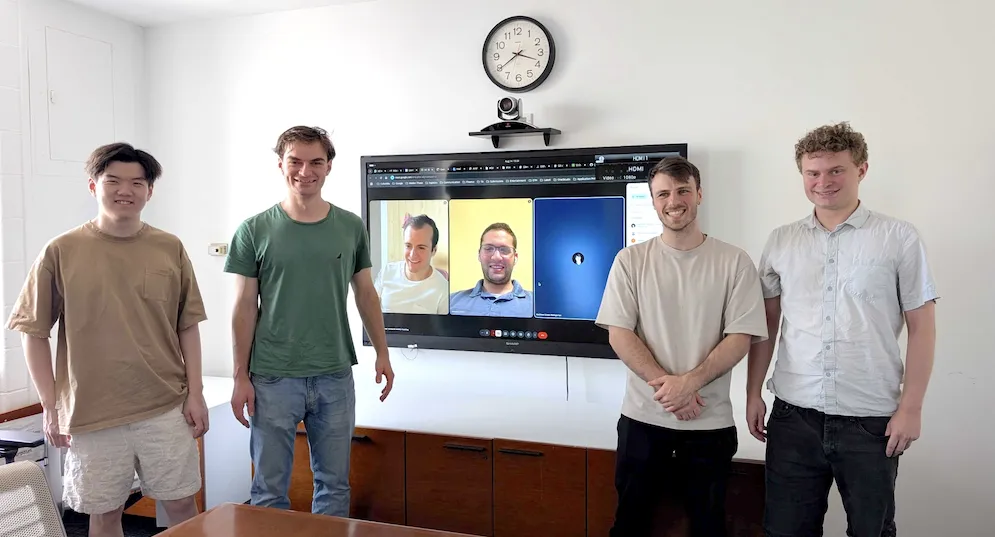
This summer, Columbia Electrical and Computer Engineering students are pursuing research projects ranging from open-source processors to embodied AI and real-time health monitoring. The program, guided by Ph.D. student Matthew Weingarten in Professor Tanvir Ahmed Khan’s ICE Lab , gives students practical experience with tools and methods used in academic and industry settings.
“Our work on performance characterization empowers students to gain hands-on experience with open-source RISC-V CPUs, GPUs, and state-of-the-art accelerators, bridging the gap between academic learning and real-world hardware design,” Weingarten said. “This expertise is crucial for advancing processing efficiency and innovation in the post-Moore era, where understanding and optimizing hardware and software interactions is more important than ever.”
Faculty Research Highlights
Professor Tanvir Ahmed Khan – ICE Lab
Students in Khan’s lab are analyzing performance monitoring hardware on RISC-V processors, investigating memory profiling tools with ARM CoreSight, and developing compiler dataflow analysis methods in the MLIR CIRCT framework. These projects combine benchmarking, C++ programming, and static analysis to explore performance bottlenecks and optimization strategies.
Professor James Anderson – Anderson Lab
Anderson’s team is focusing on model predictive planning with fine-tuned world models. The goal is to apply foundation models in sequential decision-making tasks, making reinforcement learning more adaptable and efficient in real-time, uncertain environments.
Professor Fred Jiang – Intelligent and Connected Systems Lab
Jiang’s lab is developing machine learning tools for cardiac health monitoring using wearable devices. Another project is advancing AIoT systems, including multi-sensing drones that collect and analyze environmental data for real-time decision-making.
Professor Zoran Kostic – AIDL Lab
Kostic’s research opportunities cover several applied AI topics: optimizing inference for deep learning on low-power devices, building calibration-free object detection models for smart streetscapes, developing speech-based tools for health care, creating AI methods for monitoring river pollution, and analyzing surgical procedures with video data.
Professor Nima Mesgarani – Neural Acoustic Processing Lab
Mesgarani’s group is studying how the brain processes speech by combining visual cues, acoustic data, and neural recordings. The lab is also designing new approaches to interpret large language models, focusing on methods that reduce bias in how researchers probe model behavior.
Expanding Learning Opportunities
The summer research program is open to master’s students. Depending on the project, students may register for credit or participate in non-credit research experiences. Faculty and graduate mentors guide students in developing technical expertise while contributing to projects with applications in computing, health care, and environmental sustainability.
More can be found: https://www.ee.columbia.edu/summer-research-opportunities#