Professor Homayoon Beigi Advances AI-Driven Structural Monitoring With Two New Journal Publications
Two new publications in ‘Mechanical Systems and Signal Processing’ and ‘Infrastructures’ introduce a framework for learning damage embeddings from laboratory structures and demonstrate real-time, zero-shot monitoring of unseen fully operational in-service bridges using cepstral features and different neural network paradigms.
Professor Homayoon Beigi, Professor of Professional Practice in the Department of Electrical Engineering, and his structural health monitoring lab (a collaboration with the Civil Engineering Department’s Professor Raimondo Betti), have published two significant journal papers advancing the role of electrical engineering in intelligent structural monitoring. The studies demonstrate how modern signal processing and machine-learning techniques can transform the way engineers detect, classify, and understand structural damage in real time.
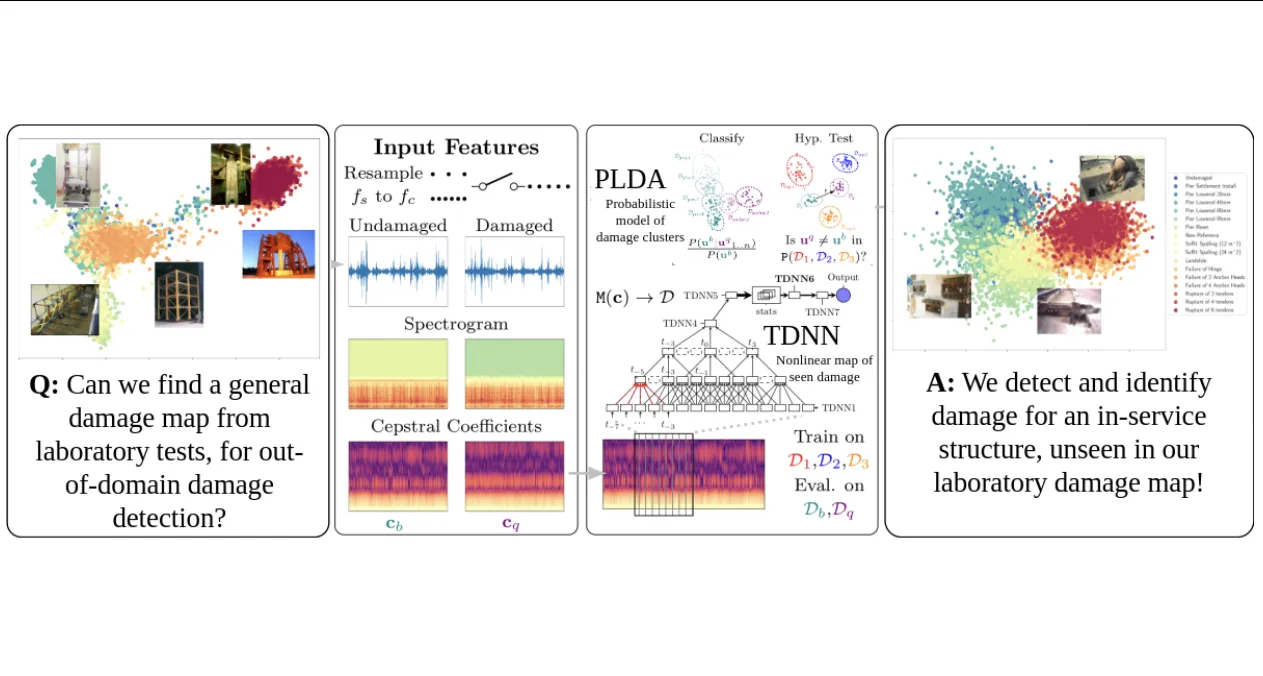
The first publication, a full-length article in Mechanical Systems and Signal Processing, introduces a new framework for learning universal damage embeddings from a wide range of laboratory test structures. The research integrates cepstral features, time-delay neural networks, and probabilistic linear discriminant analysis to create a latent damage space that captures nonlinear vibration behavior across diverse structural systems. By training on models of trusses, steel frames, reinforced concrete columns, and seismic specimens, the approach learns generalizable patterns of stiffness loss, cracking, and progressive deterioration. The method successfully applies these learned representations to the well-known Z24 Bridge benchmark, even though the bridge was never part of the training data, demonstrating a powerful form of cross-domain generalization.
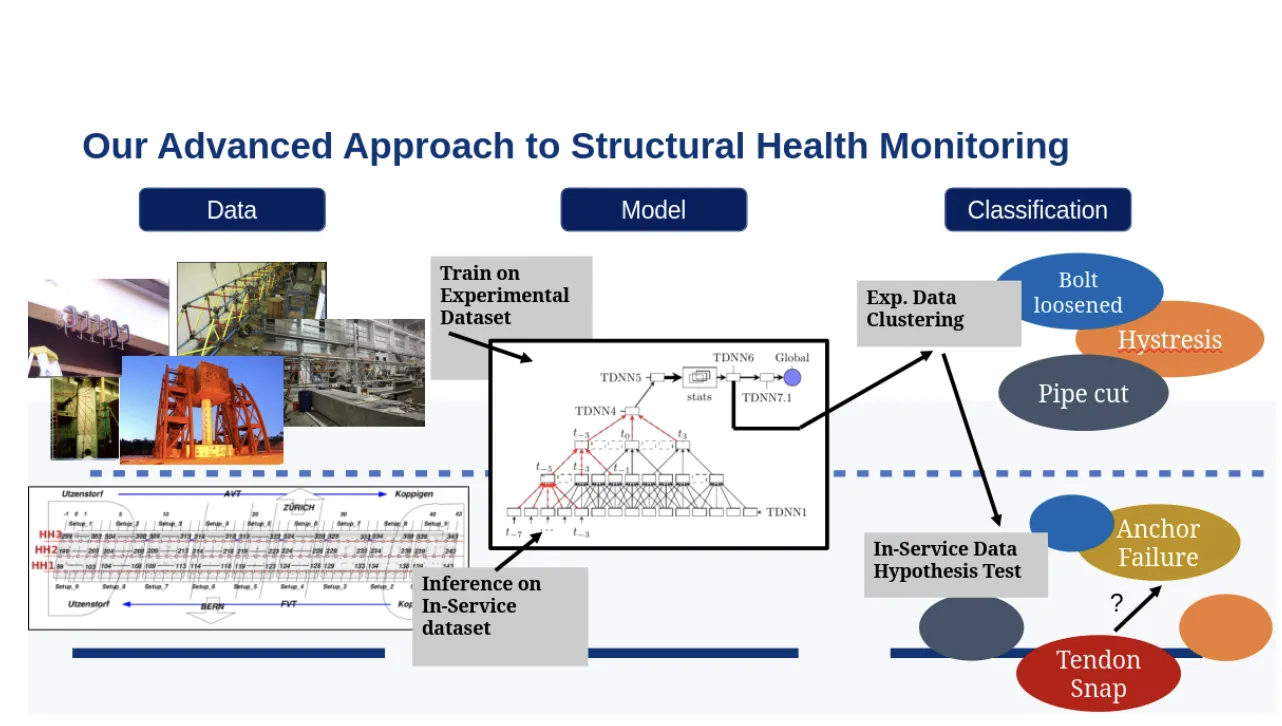
The second publication, appearing in the journal Infrastructures, presents a real-time, zero-shot monitoring system that uses cepstral features and a streaming LSTM architecture to detect damage without any structure-specific training. The framework processes acceleration signals in overlapping windows, transforms them into damage-sensitive cepstral coefficients, and uses a state-carrying LSTM network to continuously track vibration changes. Tested on the full-scale Z24 Bridge, the system reliably distinguishes healthy and damaged states and identifies damage progression in real time. The work shows how sequence-learning models originally developed for speech processing can be adapted to monitor large civil structures using only raw vibration data.
Together, these two publications highlight how engineering innovations in sensing, machine learning, and temporal signal modeling can significantly strengthen structural health monitoring. Professor Beigi’s contributions demonstrate how principles from audio processing and artificial intelligence can be translated into practical tools for safer, more resilient infrastructure.