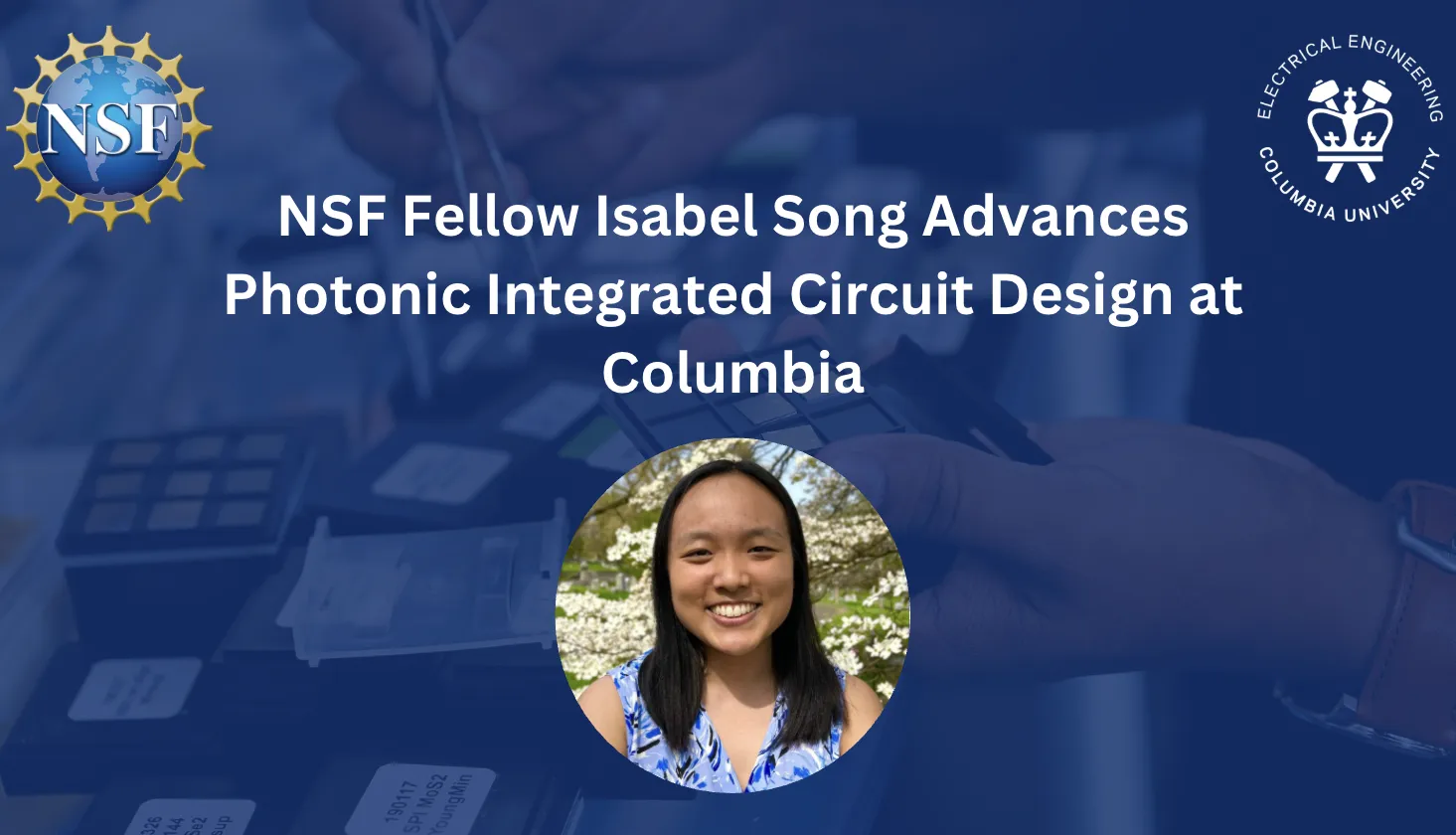
When Isabel Song joined Columbia University’s Ph.D. program in Electrical Engineering in Fall 2025, she knew she wanted to work on technology that could transform the future of computing. As a National Science Foundation (NSF) Graduate Research Fellow and Wei Family Private Foundation Fellow, Song is now conducting research under the guidance of Professor Keren Bergman, the Charles Batchelor Professor of Electrical Engineering, at the Lightwave Research Laboratory, focusing on silicon photonic integrated circuit design—a field she believes is key to meeting the world’s growing data demands.
“My primary research interest is in silicon photonic integrated circuit design, and I’m particularly excited about novel applications of photonics in large-scale systems—like computing and communications—to enhance their performance and efficiency,” said Song. “Professor Bergman is a highly distinguished researcher in optical interconnection networks for crucial applications such as reducing the power consumption of AI, and I am extremely grateful and excited for the opportunity to work with her and her group during my PhD.”
At Columbia, Song is a member of the Lightwave Research Laboratory. The group’s pioneering work integrates nanophotonics and computing, developing nanoscale photonic interconnect technologies that move data across chips and large computing systems with extreme energy efficiency. These efforts are laying the groundwork for next-generation computing platforms, where optical networks could dramatically reduce the energy footprint of data centers and artificial intelligence systems.
Before coming to Columbia, Song earned her B.S. in Electrical Engineering from the University of Pennsylvania, where she served as president of the IEEE Eta Kappa Nu Lambda Chapter. Her early experiences included designing an optical receiver and RF transmitter chip as part of an undergraduate research project, and later interning at the MIT Lincoln Laboratory, where she characterized laser frequency noise in semiconductor lasers.
The NSF Graduate Research Fellowship Program (GRFP) recognizes and supports exceptional students pursuing research-based master’s and doctoral degrees in STEM disciplines. The federally sponsored program provides up to three years of funding for graduate study to students who demonstrate both scholarly excellence and leadership potential.
Looking ahead, Song hopes to continue bridging the gap between photonics research and real-world applications. “With photonic technologies playing an increasingly central role in high-performance computing and communications,” she said, “I want my research to contribute to building systems that are not only faster, but also more sustainable and energy-efficient.”