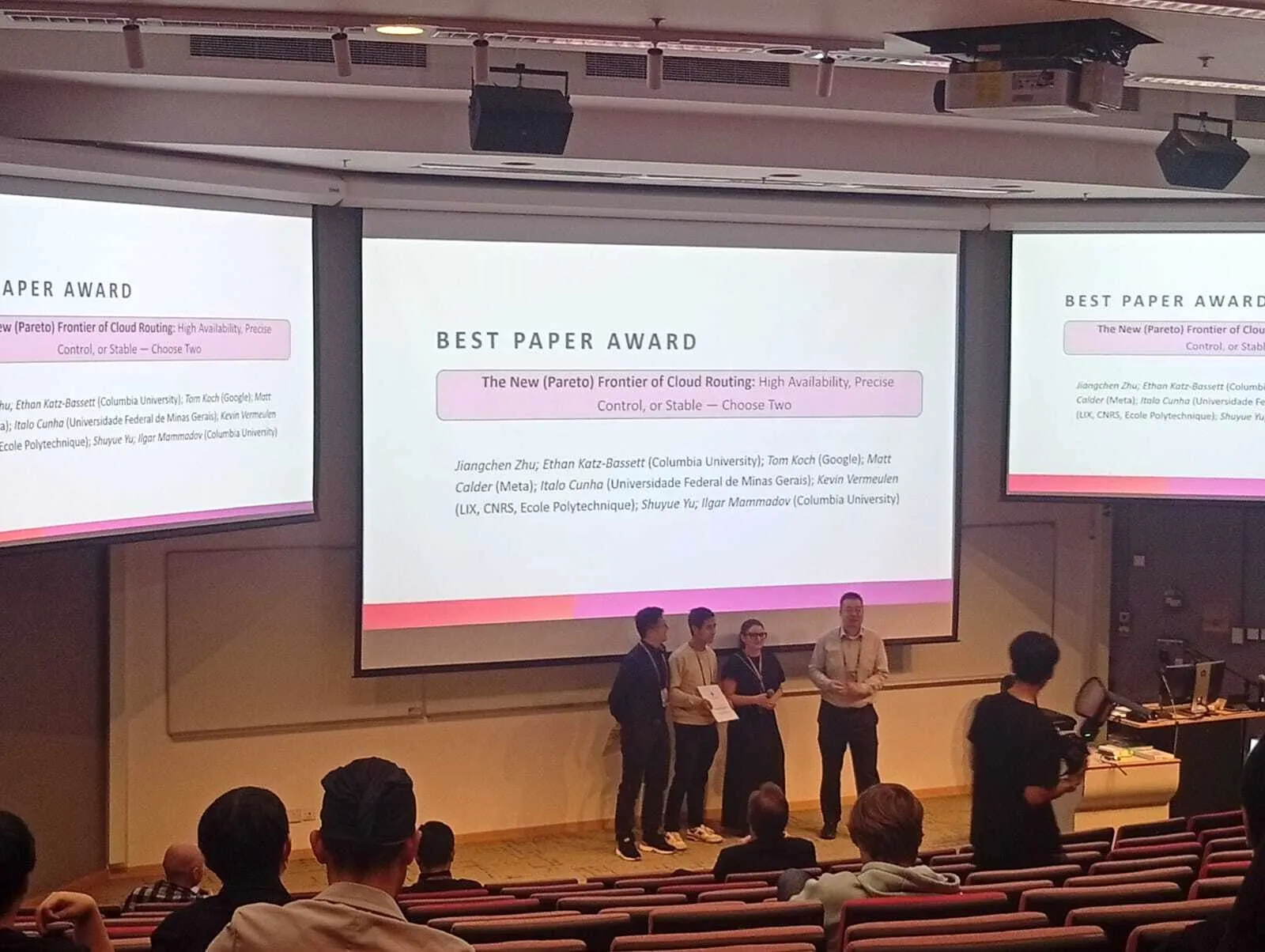
A Columbia Engineering research team led by Computer Science PhD student Jiangchen Zhu and his advisor Electrical Engineering Associate Professor Ethan Katz-Bassett has won the Best Paper Award at the 2025 ACM International Conference on emerging Networking EXperiments and Technologies, better known as CoNEXT, for their paper, “The New (Pareto) Frontier of Cloud Routing: High Availability, Precise Control, or Stable — Choose Two.”
The research team also includes Shuyue Yu, a Computer Science PhD student; Columbia Engineering alumni Tom Koch (EE PhD ’24) and Ilgar Mammadov (CE MS ’24); Kevin Vermeulen, a postdoctoral research scientist working with Professor Katz-Bassett; Matt Calder, an adjunct assistant professor at Columbia’s Data Science Institute; Ítalo Cunha, an associate professor of computer science at Universidade Federal de Minas Gerais; and Professor Katz-Bassett. Their paper received recognition at CoNEXT 2025, a leading conference in computer networking research.
Modern online services are often hosted at sites around the world, both to improve resilience and to serve users from nearby locations for better performance. That creates a challenge for cloud providers and content delivery networks: how to direct users to the right site quickly, reliably, and with enough control over where traffic goes. Under normal conditions, routing users to nearby sites can reduce latency and balance traffic. But when a site fails because of hardware issues, misconfiguration, outages, or sudden traffic spikes, the system must also redirect users quickly without overwhelming other sites.
The researchers show that cloud routing systems face a fundamental and unavoidable tradeoff among three goals: high availability, precise control, and configuration stability. Existing approaches make different compromises. Anycast can reroute traffic quickly when a site fails, but cloud operators have limited control over exactly where users are sent. Unicast with DNS-based redirection gives operators more control over which users connect to which sites, but cached DNS information can slow failover when a site goes down. The team’s paper demonstrates that no routing system can optimize all three goals at once.
Although the paper shows that this tradeoff cannot be eliminated, the researchers developed new general-purpose routing techniques that combine some of the advantages of existing approaches while reducing their weaknesses. The techniques design backup plans for failures that maintain precise control via DNS-based redirection during normal operations with fast failover to other sites similar to anycast. By carefully adjusting the routing information that sites announce to the wider internet, the techniques can help redirect users more quickly during failures, maintain greater control over which users connect to which sites, and reduce the number of potentially disruptive routing changes.
The CoNEXT honor builds on earlier recognition for the project. A preliminary version of the research was published at the 2022 ACM Internet Measurement Conference, known as IMC 2022, and won the Best Short Paper Award. That earlier work explored how hybrid routing techniques could provide both high traffic control and fast failover after site failures.
The award highlights the continued impact of Katz-Bassett’s group in internet measurement, routing, and cloud reliability research. Their work offers a path toward internet services that remain fast and reliable even when parts of the infrastructure fail.