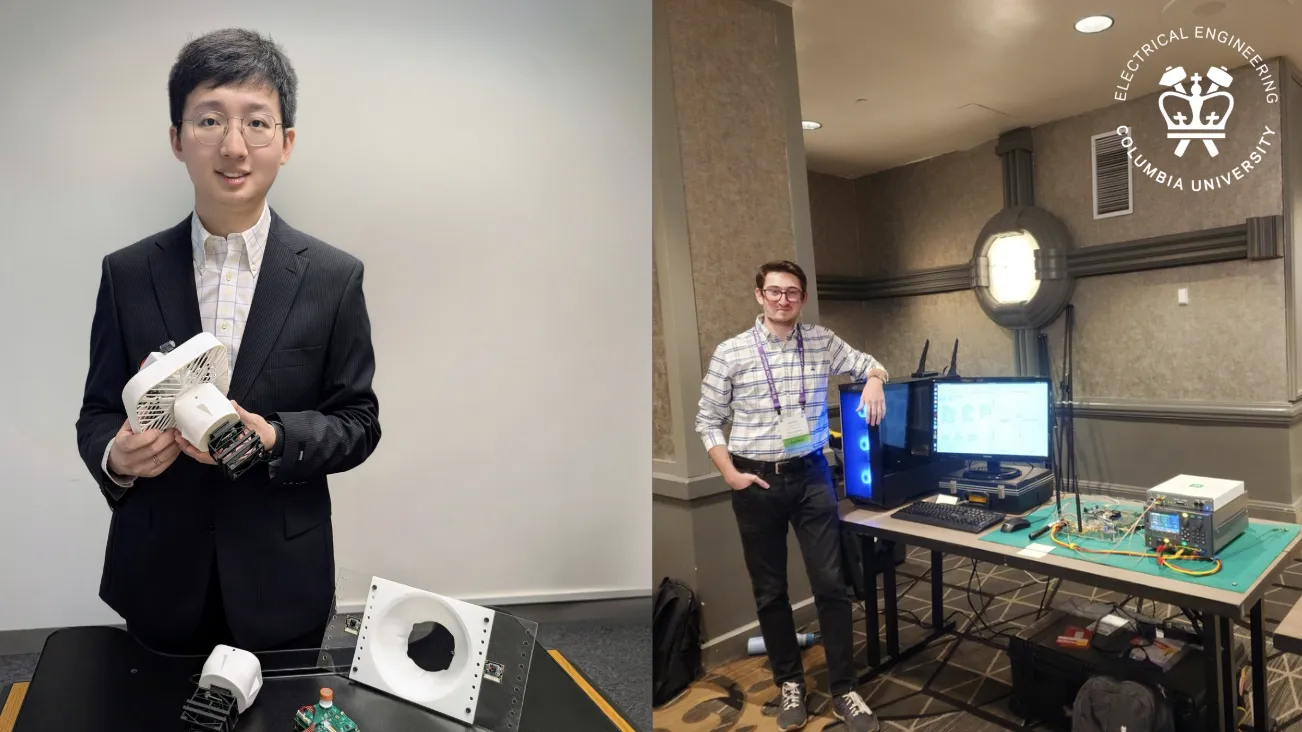
Columbia Electrical Engineering students Alon S. Levin and Minghui “Scott” Zhao have been selected for the 2026 ACM MobiSys Rising Stars Forum, a highly selective venue for early-career researchers in mobile computing, applications and services.
The forum, held in conjunction with ACM MobiSys 2026 from June 21 to 25 in Cambridge, U.K., is designed for PhD students and early-stage postdoctoral researchers to present ongoing work, receive feedback from senior researchers and build networks across the mobile systems research community. Selected extended abstracts will be included in the conference proceedings and the ACM Digital Library.
Levin, a fifth-year PhD student in Professor Gil Zussman’s Wireless and Mobile Networking Lab, will present “Enabling Practical Full-Duplex Wireless: From Circuits to Software” during the forum’s Wireless Communication and Networking session. His research focuses on next-generation wireless communications, particularly adaptive full-duplex wireless systems that can transmit and receive simultaneously on the same frequency. These systems aim to increase network capacity and spectral efficiency while responding to changing real-world environments.
As part of his doctoral work, Levin has contributed to the development of the third generation of full-duplex transceivers within the FlexICoN project, enabling wideband operation with environment-aware adaptive analog cancellation. He was also supported by the National Defense Science and Engineering Graduate (NDSEG) Fellowship from 2022 to 2025 and recently received the Fulbright fellowship. He has also received the Byron Fellowship from Columbia Engineering and the Jacob Millman Award for Outstanding Teaching Assistants, and won First Place in the ACM SIGCOMM’23 Student Research Competition (SRC).
Zhao, who recently defended his PhD in Columbia Engineering’s Department of Electrical Engineering, conducted his doctoral research in Professor Xiaofan (Fred) Jiang’s Intelligent and Connected Systems Lab. He will present “Democratizing Physical AI via Hardware-Software Co-design for Everyday Environments” during the forum’s Physical AI session. His research lies at the intersection of embodied AI, cyber-physical systems and mobile computing, spanning autonomous robotics, the Internet of Things and smart health.
Zhao develops hardware-software co-designed systems that make physical AI more accessible and practical in everyday environments. His work includes autonomous reconfigurable drones, programless smart home systems and resource-efficient wearable interfaces, all aimed at enabling AI systems to perceive, understand and act effectively in the physical world. His doctoral research was supported by the National Science Foundation and the Semiconductor Research Corporation.
Zhao’s research has been recognized at leading venues in mobile and embedded systems. His honors include a Best Paper Award at ACM HumanSys, a Best Demo Award at ACM/IEEE IPSN, Best Demo Runner-Up Awards at ACM MobiCom and ACM SenSys, and second place in the ACM Student Research Competition. He also received Columbia Electrical Engineering’s Jacob Millman Award for Outstanding Teaching Assistants.
Levin and Zhao’s selections underscore Columbia EE’s growing strength in mobile systems and physical AI research, from the wireless infrastructure that supports future networks to the embodied AI systems that bring computation into the physical world.