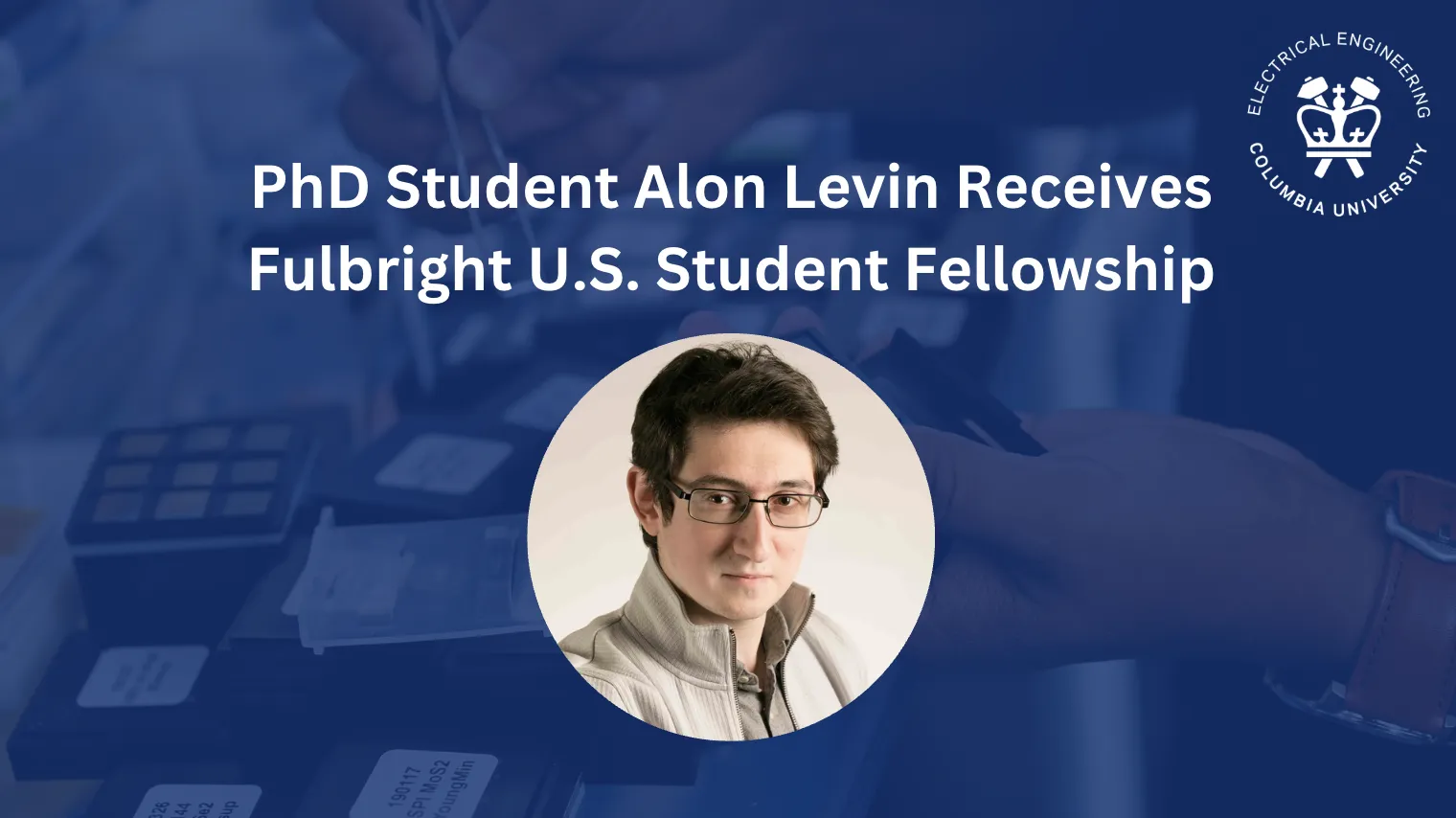
Alon Levin, a doctoral student in Columbia Engineering’s Department of Electrical Engineering, has received a Fulbright U.S. Student Fellowship for the 2025–2026 academic year. Through the award, Levin will spend a semester conducting research at the Technion–Israel Institute of Technology in Israel.
Fulbright U.S. Student Fellowships, offered annually in more than 140 countries, support graduating seniors and alumni pursuing independent research projects, graduate study, or English-language teaching opportunities abroad. The program is one of the nation’s most prestigious international exchange fellowships.
Levin is a fifth-year PhD student in the Wireless & Mobile Networking Lab, advised by Prof. Gil Zussman. His research focuses on next-generation wireless communications, with a particular emphasis on adaptive full-duplex wireless systems, which allow devices to transmit and receive signals simultaneously on the same frequency. Such systems have the potential to address growing demands for wireless capacity and spectral efficiency.
As part of his doctoral work, Levin has contributed to the development of the third generation of full-duplex transceivers within the FlexICoN project. These transceivers are designed for wideband operation and feature environment-aware adaptive analog cancellation, enabling more efficient wireless communication in complex and changing environments.
At the Technion, Levin will join Prof. Alejandro Cohen’s research group to study physical-layer security applications uniquely enabled by full-duplex transceivers.
“I am very excited to have received the Fulbright fellowship and to be spending a semester with Prof. Cohen’s group at the Technion,” Levin said. “Full-duplex wireless holds enormous potential — not just for network efficiency, but for how we view and interact with the wireless spectrum as a whole. My work at Columbia has focused on building practical, adaptive full-duplex systems; now, the conversation is shifting to what unique applications this technology makes possible, including physical-layer security capabilities that today’s half-duplex transceivers simply cannot support.”
Levin’s Fulbright research builds on his broader work advancing wireless systems that are faster, more adaptive, and more secure. From 2022 to 2025, he was supported by the National Defense Science and Engineering Graduate (NDSEG) Fellowship, a highly competitive fellowship awarded to promising doctoral students in science and engineering fields of interest to the Department of Defense. He has also received the Byron Fellowship from Columbia Engineering and the Jacob Millman Award for Outstanding Teaching Assistants, and won First Place in the ACM SIGCOMM’23 Student Research Competition (SRC).