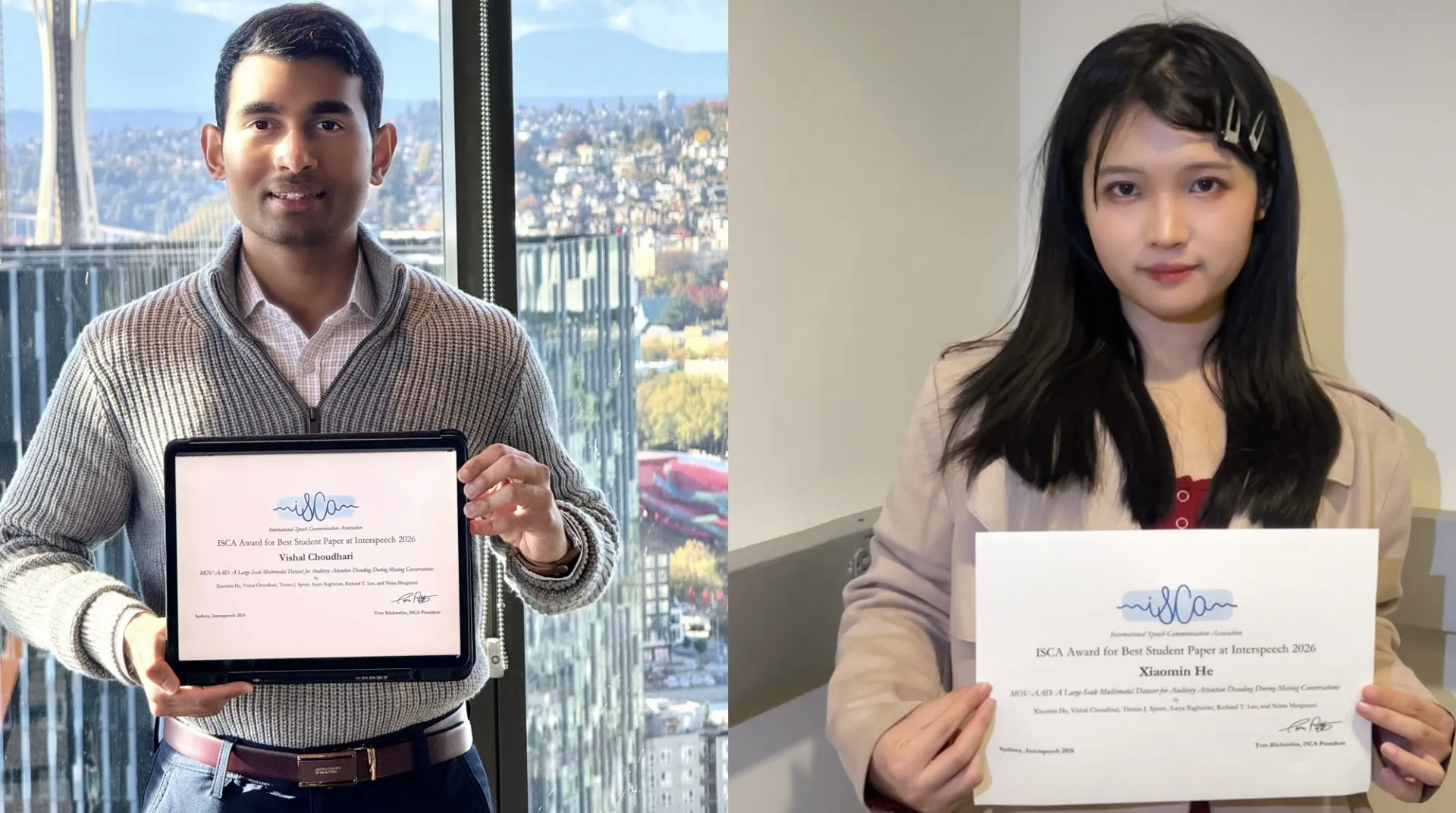
Columbia Electrical Engineering PhD student Xiaomin He and alumnus Vishal Choudhari, researchers in Electrical Engineering Department Associate Professor Nima Mesgarani’s Neural Acoustic Processing Lab, received a Best Student Paper Award at Interspeech 2026 in Sydney, Australia, for their work on a new dataset that could help advance brain-controlled hearing technologies.
Their paper, “MOV-AAD: A Large-Scale Multimodal Dataset for Auditory Attention Decoding During Moving Conversations,” was one of three selected from more than 1,300 accepted papers for the Best Student Paper Award at Interspeech 2026. Organized by the International Speech Communication Association (ISCA), Interspeech is the largest and most comprehensive annual conference on the science and technology of spoken language processing. The awards are selected through a process involving anonymous reviews and evaluation by a jury representing the ISCA Board, Interspeech Area Chairs, and Technical Program Chairs.
Advancing Brain-Controlled Hearing in Real-World Environments
Brain-controlled hearing technology aims to help people better hear the person they want to listen to in a noisy environment by using neural signals to determine and selectively enhance whom they are paying attention to. Such systems could eventually contribute to hearing devices that respond more naturally to a listener’s attention.
Previous research in auditory attention decoding has often relied on controlled listening scenarios. The Columbia team developed MOV-AAD to study how the brain processes speech under more dynamic conditions, including conversations involving moving sound sources and competing speakers.
The dataset includes recordings from 50 participants and combines synchronized neural, physiological, behavioral, and eye-tracking measurements. Participants completed tasks ranging from basic auditory validation to listening to natural conversations with moving speakers and selectively attending to one conversation while ignoring another.
By capturing listening behavior under more realistic conditions, MOV-AAD provides researchers with a resource for studying selective auditory attention and developing new approaches in auditory neuroscience, brain-computer interfaces, and hearing technologies.
The project was led by co-first authors He and Choudhari with Mesgarani, professor of electrical engineering. Tristan J. Spratt, Aarya Raghavan, and Richard T. Lee also contributed to the research, including experimental implementation and data collection.
MOV-AAD has been released for use by the broader research community, along with supporting code and documentation, allowing other researchers to build on the team’s work.