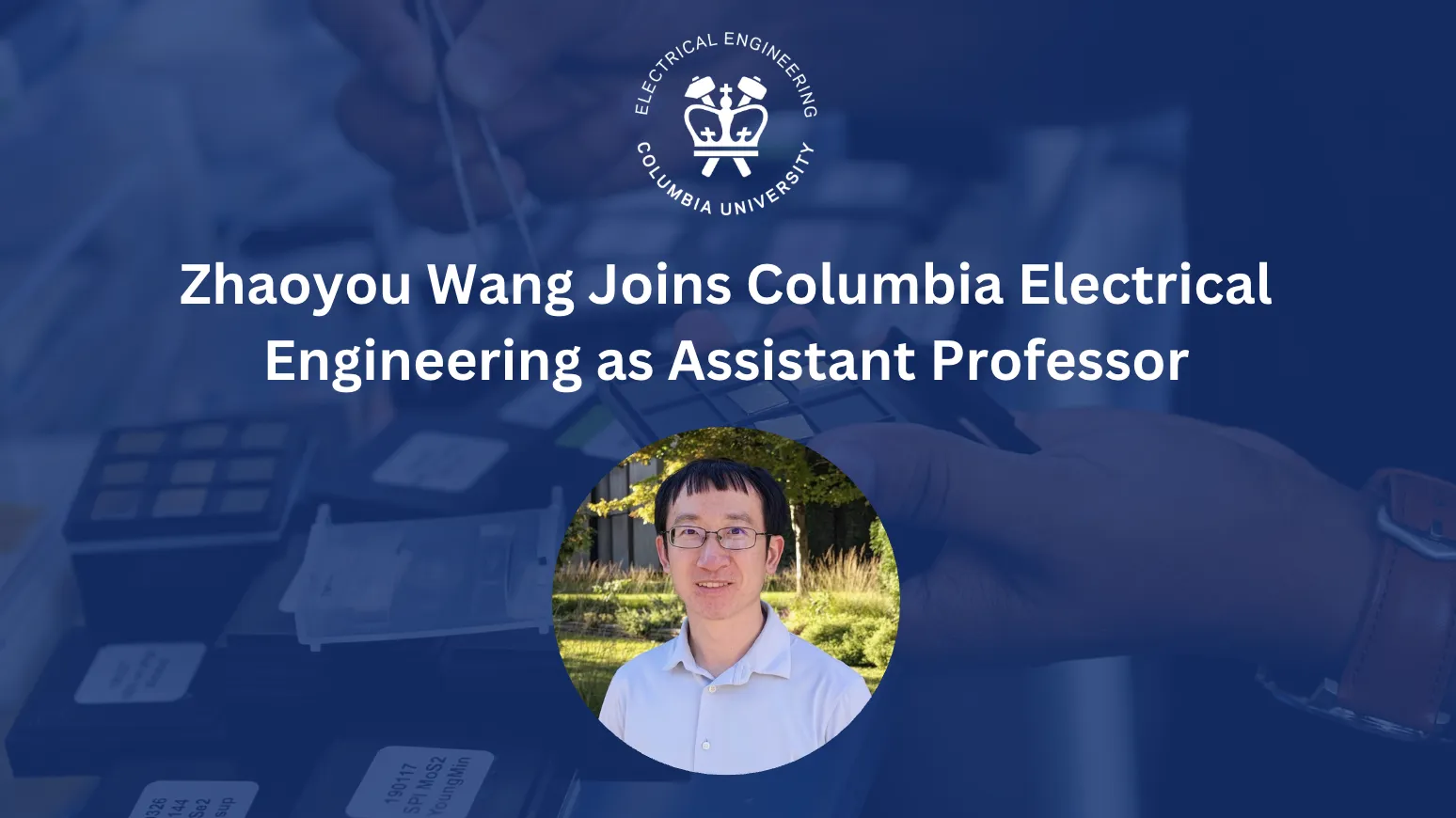
Zhaoyou Wang will join the Department of Electrical Engineering at Columbia University as an assistant professor starting in the Spring 2026 semester. He received his Ph.D. in applied physics from Stanford University and his B.S. in physics from Tsinghua University. Prior to his appointment at Columbia, Wang served as a postdoctoral researcher at the Pritzker School of Molecular Engineering at the University of Chicago.
Quantum technologies today are fundamentally constrained by noise and decoherence at the hardware level—challenges that require coordinated efforts across physics, engineering, and theory. Wang’s research addresses these limitations by developing methods to control and protect quantum information systems at the physical layer, while also probing the theoretical limits of their performance. By designing and analyzing protocols that explicitly account for physical constraints, his work aims to bridge the gap between fundamental quantum theory and practical quantum engineering.
Before joining Columbia, Wang worked on hardware-efficient techniques for manipulating quantum information across multiple platforms, including superconducting circuits and quantum acoustics. His research has also explored improved approaches to quantum transduction—the process of interfacing distinct physical systems to enable coherent information transfer. In recent work, Wang demonstrated that bosonic encodings, such as Gottesman–Kitaev–Preskill (GKP) codes, can preserve quantum information during transduction even in the presence of significant loss.
At Columbia, Wang will be teaching a new class in the spring (EECS 6890) on "Quantum Engineering” and establishing a research group focused on advancing the physical foundations of quantum information processing, with the long-term goal of enabling more robust and scalable quantum technologies.