Professor Matthias Preindl and Matthew Jahnes (PhD EE ’24) Win First Place IEEE Transactions on Power Electronics Prize Paper Award
IEEE honors the Columbia Electrical Engineering team’s groundbreaking three-phase soft-switched inverter design with its top prize paper award.

Matthias Preindl, Associate Professor of Electrical Engineering, Director of the Columbia Center of Advanced Electrification (CCAE) and his student Matthew Jahnes (PhD EE ’24) have received the 2024 IEEE Transactions on Power Electronics (TPEL) First Place Prize Paper Award for their publication, “A Three-Phase Partial Power Processing Soft-Switched Inverter.”
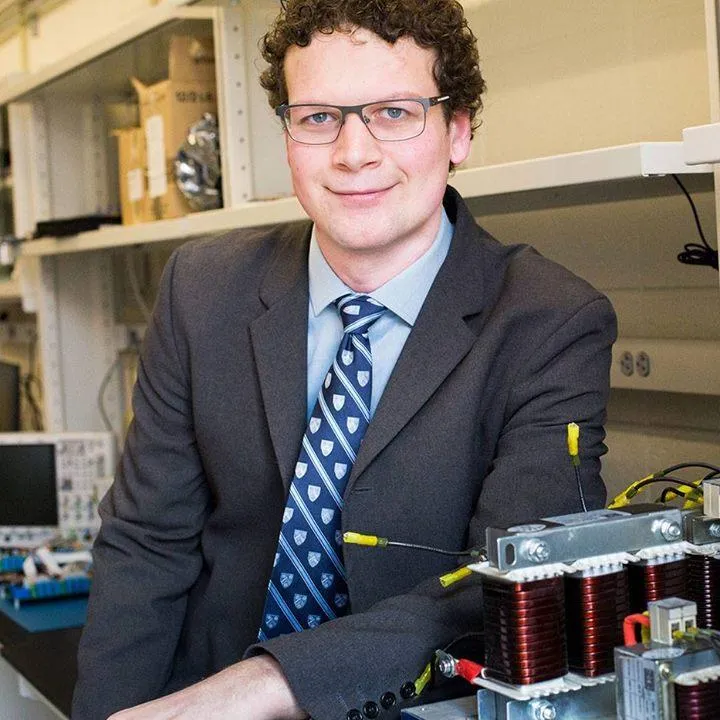
The First Place Prize Paper Award is the highest annual honor bestowed by the IEEE Power Electronics Society (PELS) for work published in its flagship journal, IEEE Transactions on Power Electronics. Selected through a rigorous review process, award-winning papers represent the most outstanding contributions from the preceding year, with emphasis on originality, analytical depth, experimental validation, and clarity of presentation. This paper was selected from 1086 papers published in IEEE Transactions on Power Electronics during the year of 2024.
Jahnes and Preindl’s study introduces a novel three-phase partial power processing (PPP) soft-switched inverter architecture that breaks with conventional full-power conversion approaches. Instead of subjecting the entire system power to high-frequency switching, their architecture processes only a well-defined fraction of the total power, marking a significant conceptual shift in inverter design. This PPP strategy—combined with a fully soft-switched three-phase topology—enables soft switching across all phases and over a wide operating range, dramatically reducing switching losses, thermal stress, and electromagnetic interference. By limiting high-frequency processing to a partial-power path, the architecture achieves higher overall efficiency and scalability, offering a distinctive advantage for demanding applications.
In the paper’s experimental sections, the authors validate the partial power processing topology using detailed waveforms and hardware measurements that demonstrate consistent soft-switching behavior under varied load conditions. Their results highlight the technology’s potential for high-performance, scalable inverter systems and exemplify the type of innovation that the TPEL award seeks to recognize.
Read the full paper here.