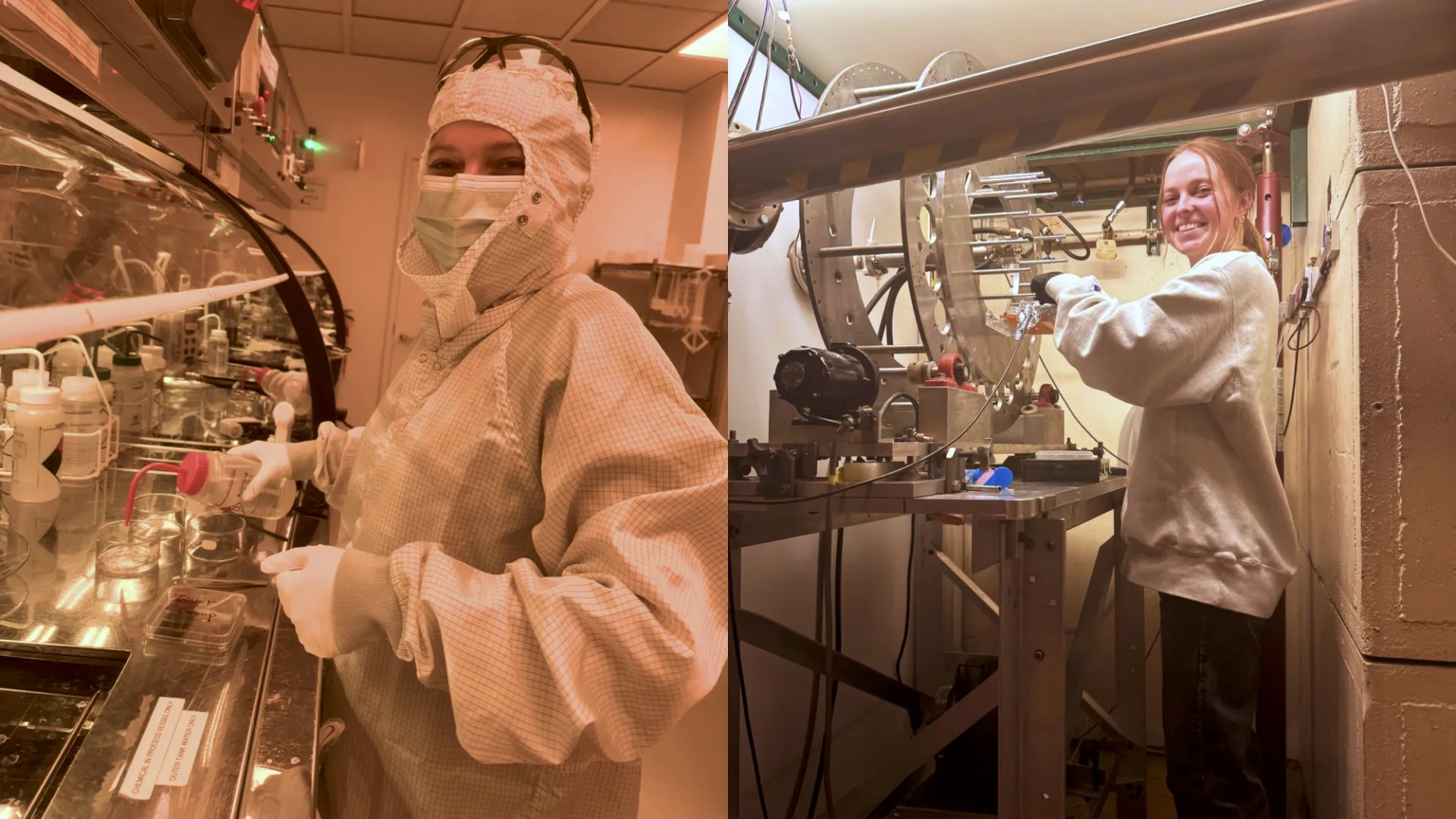
When spacecraft and hypersonic vehicles push into extreme flight regimes, engineers face a persistent problem: how to measure pressure and temperature in environments where most sensors fail. For Electrical Engineering Ph.D. student Cierra Anderson, solving that challenge is now the focus of her NASA Advanced Air Vehicles Program (AAVP) Fellowship, which began in 2025.
Anderson, who works under principal investigator and Assistant Professor in the Department of Electrical Engineering Savannah Eisner, is developing a wide-range pressure sensor designed to operate in conditions reaching 1,000 degrees Celsius and 3,000 pounds per square inch. These sensors are critical for validating computational fluid dynamics (CFD) models, particularly in regions closest to combustion chambers where existing sensing technologies cannot survive and experimental data remains limited.
“The goal is to enable reliable measurements in environments that are currently data-poor,” Anderson said. “That data is essential for improving predictive models and ultimately advancing hypersonic vehicle design.”
Achieving that reliability requires fundamental advances in high-temperature electronics. Anderson’s work focuses on sensor packaging strategies, development of high-temperature-stable ohmic contacts, and sensitivity characterization to maintain high signal-to-noise ratios — priorities outlined in NASA’s AAVP fellowship solicitation.
A key component of the project is exploring gallium nitride (GaN) pressure transducers as an alternative to the silicon carbide (SiC) technologies currently under development across the field. While SiC has been widely studied for harsh-environment electronics, GaN offers unique advantages through its heterostructures and naturally formed two-dimensional electron gas (2DEG), which can enable high-sensitivity operation even under extreme thermal and pressure loads.
Anderson’s research will compare multiple sensing approaches, including capacitive, piezoresistive and resonance-based transduction mechanisms. The project also includes optimizing GaN contact metals, developing harsh-environment packaging methods and conducting in situ testing at NASA facilities.
Most of the experimental work will be conducted at Columbia Engineering, with Anderson spending summers at NASA, including planned testing collaborations at NASA Glenn Research Center. The work builds on NASA’s broader effort to develop on-chip integrated temperature and pressure sensors for advanced air vehicle platforms. By investigating GaN as an alternative material platform, Anderson’s research could expand the design space for next-generation sensing systems capable of operating in previously inaccessible environments.
For Eisner’s research group, the fellowship reinforces EE’s growing presence in high-temperature electronics and extreme-environment sensing — areas that are increasingly important for aerospace, energy and advanced manufacturing applications.