Honoring the Legacy of Richard M. Osgood Jr.
A new commemorative plaque recognizes the pioneering scientist, mentor, and longtime Columbia Engineering professor whose work helped shape photonics and strengthen the University’s research infrastructure.
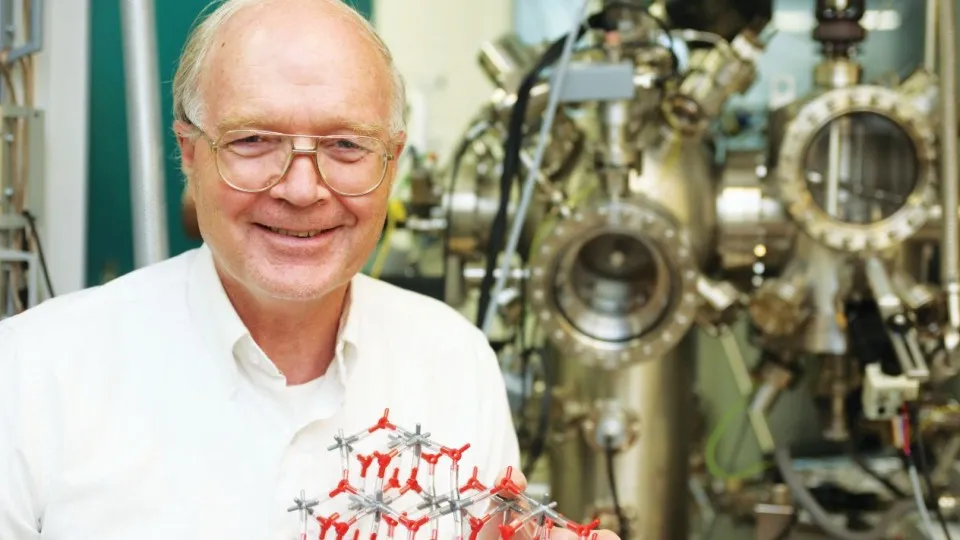
Columbia Engineering has installed a commemorative plaque honoring the late Richard “Rick” M. Osgood Jr., the Higgins Professor Emeritus of Electrical Engineering and Professor Emeritus of Applied Physics and Applied Mathematics, recognizing more than three decades of research, teaching, mentorship, and leadership at Columbia. It is located on the 10th Floor of Schapiro CEPSR, near the entrance of the Columbia Nano Initiative (CNI) Clean Room.
Osgood, who died in 2023 at age 79, joined Columbia in 1981 and remained on the faculty until his retirement in 2014. A pioneer in laser science, photonics, surface physics, and optical materials, he helped establish research programs and facilities that continue to support generations of Columbia engineers and scientists.
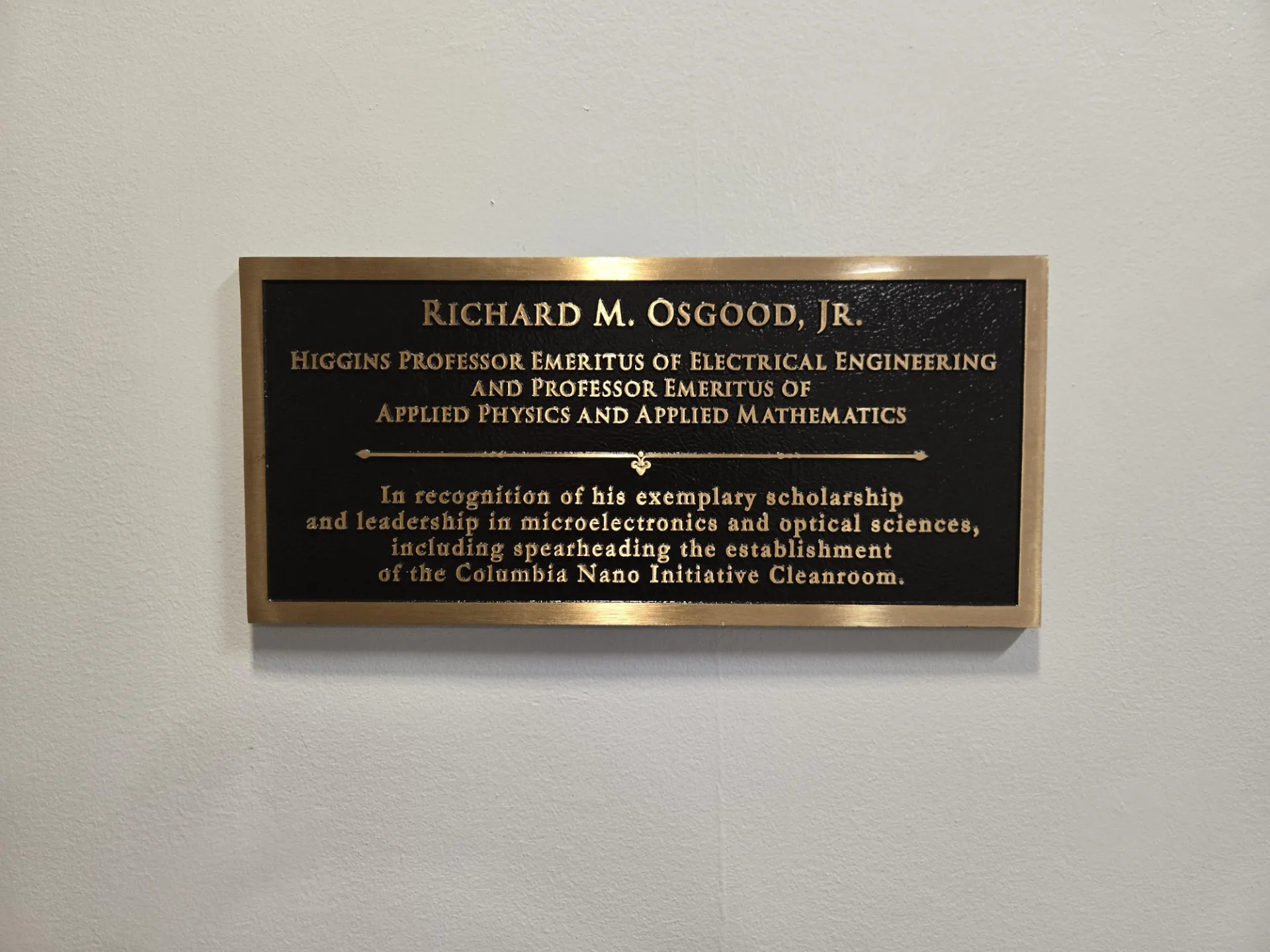
The plaque offers a permanent reminder of a legacy that extends well beyond Osgood’s own scientific discoveries. During his career at Columbia, he trained 67 doctoral students and played a central role in building the infrastructure and research community that helped establish Columbia University as a leader in optics, photonics, and microelectronics.
Osgood co-founded Columbia’s Microelectronics Sciences Laboratories and served as its director or co-director, as well as holding leadership roles in the Columbia Radiation Laboratory and the Center for Integrated Science and Engineering, the forerunners of the current Columbia Nano Initiative. He led the development of Columbia’s first shared clean-room fabrication facility, providing researchers across disciplines with access to advanced microfabrication capabilities. Irving P. Herman, Armstrong Professor Emeritus of Applied Physics and long-time friend and colleague of Osgood, notes: “Without Rick Osgood’s earnest and energetic leadership, the clean room space would not exist in CEPSR or elsewhere on campus. This Clean Room has been a game changer for research in SEAS and Columbia.”
His research spanned several generations of optical science. Early in his career, Osgood helped develop the high-power carbon monoxide laser while serving in the U.S. Air Force. After completing his PhD at MIT under laser pioneer Ali Javan, he worked at MIT Lincoln Laboratory, where his research helped establish the field of laser-induced photochemical deposition and surface reactions.
At Columbia, his work encompassed laser processing, nonlinear optical materials, surface chemistry, silicon photonics, and plasmonics. His research produced hundreds of peer-reviewed papers and contributed to technologies that moved beyond the laboratory. In 1995, his research group developed the photonic design software that became RSoft, a commercial company specializing in photonic and optical design tools.
In 1991, Osgood received the Optical Society's R. W. Wood Prize with Daniel J. Ehrlich and Thomas F. Deutsch for their invention of laser photochemical deposition and its application to materials processing. He was also elected a fellow of Optica, the American Physical Society, and IEEE. From 2000 to 2002, while on leave from Columbia, he served as associate director of energy sciences at Brookhaven National Laboratory.
Osgood’s work also helped connect communities across Columbia. With appointments in both the Departments of Electrical Engineering and Applied Physics and Applied Mathematics, he worked at the intersection of engineering, physics, materials science, and optics long before such cross-disciplinary collaborations became common. The new plaque now makes that contribution visible to the students and researchers who continue to work in the spaces and fields that Osgood helped build.
Read original news story here.