EV owners are using their trucks’ giant batteries to prevent blackouts
Matthias Preindl, director of the Center of Advanced Electrification at Columbia University and EE professor featured in the Washington Post article, commenting on how electric cars and trucks can use their huge batteries to power your home during a blackout.
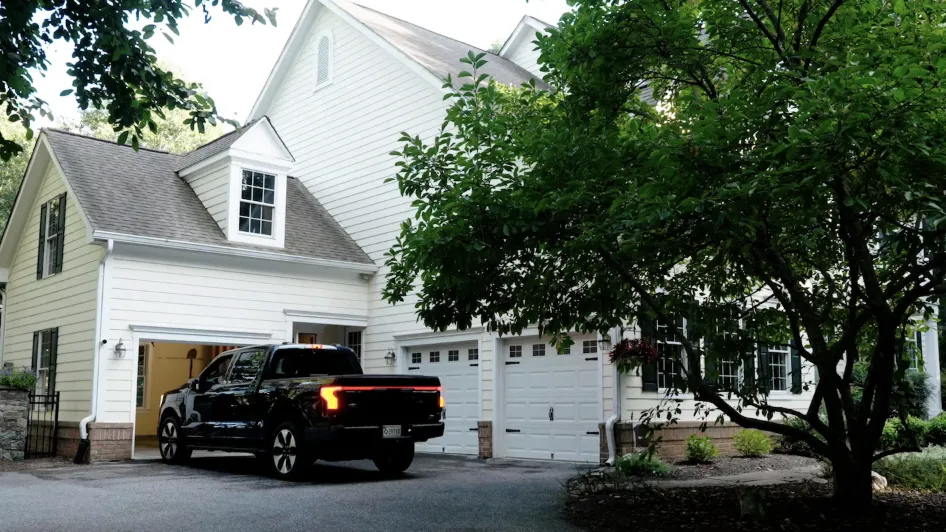
Brian Foreman and his wife, Christy, were getting ready to make dinner at their home in Highland, Maryland, when the power went out.
While the lights winked out around their neighborhood last May, Foreman went into the garage and plugged their electric pickup truck into the wall. A few moments later, the lights, refrigerator and the air fryer they had been using to make chicken tenders sprang back to life. The outage lasted six hours, but Foreman estimates they could have kept their house running for a week without power.
“It’s amazing,” Foreman said. “We can still cook dinner, we can put the TV on, we can use the internet, we’ve got water. You can turn the AC on, or if it’s cold turn the heat on. It lets you continue life as usual.”
Now, Foreman’s truck isn’t just protecting his home from blackouts — it’s helping prevent blackouts across his neighborhood by sending some of the energy stored in its massive battery back to the grid when there’s a looming threat of an outage. Foreman is one of three Baltimore Gas and Electric (BGE) customers who signed up for a pilot program this year to test the idea. The power company paid customers hundreds of dollars in exchange for tapping into their trucks’ batteries.
Other pilot programs have tested the concept in at least 19 U.S. states as well as China, Australia, Canada, the United Kingdom and several E.U. countries. If these programs catch on, experts say they’ll unlock a vast new source of backup power to stabilize strained grids during crises.
“These pilot programs show that you can do it,” said Matthias Preindl, director of the Center of Advanced Electrification at Columbia University. “Vehicles already store a lot of power and energy. If utilities can tap into that, in particular for the hottest or coldest days of the year, then that can be quite helpful to manage the electric grid.”
Cars and trucks store more energy than all the stationary batteries built to back up homes, businesses and utilities, combined. EV batteries are huge: The 1,800-pound battery in Foreman’s Ford F-150 Lightning can store about as much energy as 10 Tesla Powerwall home batteries. That’s enough to power the average U.S. household for four-and-a-half days — or longer if residents use less energy during a blackout.
Foreman ordered his truck in 2021 after reading about Texas homeowners who had used their F-150 hybrids to power their homes during the deadly blackouts that followed Winter Storm Uri that year. At first, Foreman looked into buying home batteries for backup power, but he realized an electric truck could do the same job with extra benefits.
“To buy a 10 Powerwall system from Tesla, you’re spending $50,000, $60,000, $70,000,” Foreman said. “I’m like, ‘Well, that just gives you the [battery] on the wall. I spent just about that much money, and I have a truck I can drive around.’”
Utilities would like to tap into EV batteries for emergency power in moments of crisis. They already pay customers to let them borrow energy from their home batteries or turn off their air conditioners and other appliances a few times a year. Cars and trucks are one more source of emergency power that utilities could quickly add to their tool kits, even as they slog through the years-long process of building new power plants to keep up with rising energy demand.
“These solutions are a lot faster to roll out,” said Divesh Gutpa, director of clean energy solutions at BGE. “They can solve some of the problems … before you’re able to bring online large-scale generation.”
It’s getting easier for EV owners to use their cars for backup power. Automakers including Tesla, GM, BMW, Hyundai, Kia, Volkswagen, Ford and Nissan now sell electric cars and trucks with “bidirectional charging,” the feature that allows them to power buildings, tools, appliances or the grid. And companies are developing smarter home chargers that can figure out when an EV should send power from its battery to the grid and when it needs to charge the battery to make sure it has enough range for the next day’s commute.
But there are still plenty of headaches.
Foreman, who has spent 33 years working in IT, enjoyed working out the kinks of a new technology.
“I’m an early adopter on a lot of things … but I think that’s different than the typical person,” Foreman said. “There’s some effort required from anyone to get this system to work. You’ve got to be willing to spend a little bit of time on this and understand it’s still in the early stages.”
During the BGE pilot program, which ran from July through September, Foreman said he made about $400 in profit selling energy from his EV battery to the power grid on weekdays between 5 p.m. and 9 p.m. He didn’t have to be home with his truck plugged in during those hours — but if he happened to be there his F-150 would automatically use its battery to power his house and his neighbors’ homes, and then charge itself back up overnight.
BGE tapped into Foreman’s battery almost every day to test the system as much as possible during the pilot program. But when the company expands the program for more customers it will use their EV batteries much less frequently, Gupta said.
“Your electric vehicle is going to be great at making you money those couple of dozen of days a year — you know, probably less than 100 hours a year — when the grid is at its greatest strain and it’s really valuable to export energy back out of the car to the grid,” said Chris Rauscher, head of grid services and electrification at Sunrun, which partnered with BGE and Ford on the pilot program.
The biggest remaining challenge is persuading EV drivers to sign up. Customers, including Foreman, worry about putting extra wear-and-tear on their batteries and making sure they’ll have enough charge left to drive. To win customers over, companies could guarantee that participating EV batteries will live up to their warranties, that the utility will never use more than an agreed amount of a customer’s battery and that customers can always opt out of the program, according to Preindl, the Columbia engineer.
“You need to mold it into a simple enough package for the average user that fundamentally just wants to drive their car,” Preindl said.
Having gone through the pilot program, Foreman expects it’ll take some time for car, power and energy companies to iron out the details.
“I absolutely want everyone to do this — plug into the grid and use the batteries and just make everything better and more resilient,” Foreman said. “I wish all the manufacturers would make this easier to do, and I wish the utilities would compensate us more to do it. I think that’s the future. It’s just going to take a while.”
Read original story here.