Savannah Eisner Wins NSF CAREER Award for Extreme Environments Electronics
The Columbia electrical engineering professor will develop degradation-aware gallium nitride circuits designed to operate in harsh settings, from planetary exploration to nuclear energy systems.

Columbia Electrical Engineering Assistant Professor Savannah Eisner has received a National Science Foundation CAREER award for her project, “CAREER: Degradation-Aware GaN Electronics for Mixed-Signal Integration in Extreme Environments.”
The NSF Faculty Early Career Development Program, known as CAREER, supports early-career faculty who have the potential to serve as academic role models in research and education. Eisner’s award will support her work to build the scientific foundation for reliable electronics that can withstand some of the world’s harshest operating conditions, including the surface of Venus, the interiors of nuclear reactors, hypersonic aerospace platforms and other extreme environments.
The award also supports an integrated education and outreach program. Eisner will expand her graduate-level course, Harsh Environment Electronics, into a research-informed, lab-based experience that introduces students to device modeling, thermal reliability, and circuit testing. Students will work with experimental data from wide-bandgap devices and use professional modeling tools to study how electronics behave under temperature and radiation stress.
Through the CAREER project, Eisner aims to train the next generation of engineers to design electronics for real-world conditions that go far beyond the lab. “I aim to build the intellectual tools and expertise needed to enable GaN heterostructure electronics to function reliably where no electronics have before,” Eisner says.
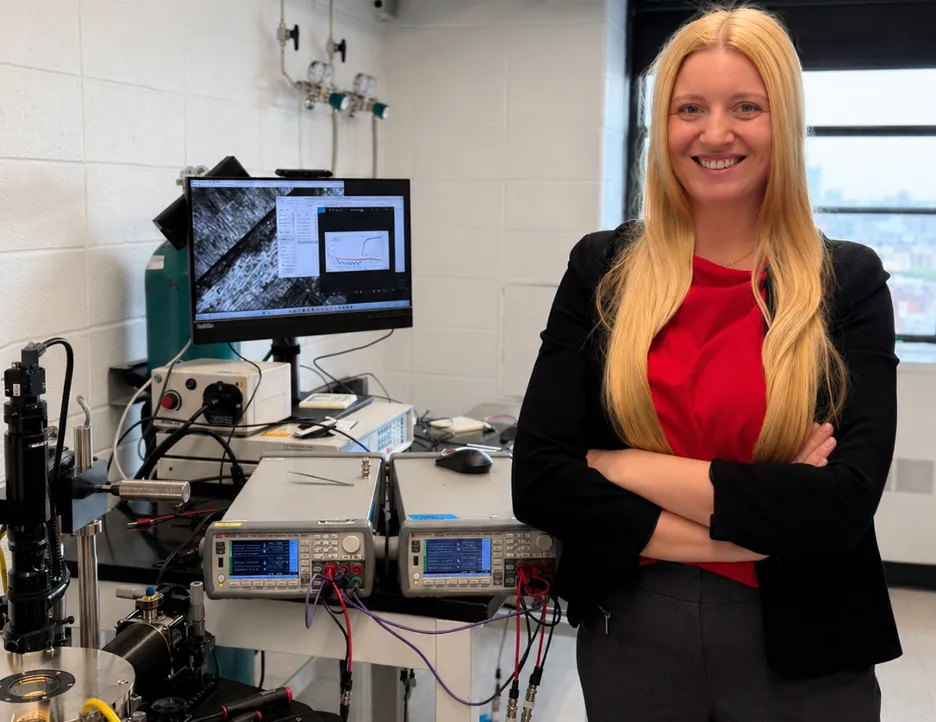
Conventional silicon-based electronics begin to fail at high temperatures, limiting their use in environments where cooling, shielding or repair may be impossible. Eisner’s project focuses on gallium nitride, or GaN, a wide-bandgap semiconductor known for its thermal stability, radiation tolerance and high electron mobility. While GaN transistors have shown promise, their use in complete systems has been limited by a lack of understanding of how analog circuits and passive components degrade under long-term heat, radiation and electrical stress.
Through the project, Eisner will develop and test GaN-based circuits and integrated passive components designed to operate at temperatures above 500 degrees Celsius for extended periods and in radiation-rich environments. Her research group will focus on indium aluminum nitride/gallium nitride heterostructure high electron mobility transistors, along with co-fabricated capacitors, resistors, inductors and interconnects. The work will combine device modeling, high-temperature testing and degradation-aware circuit design.