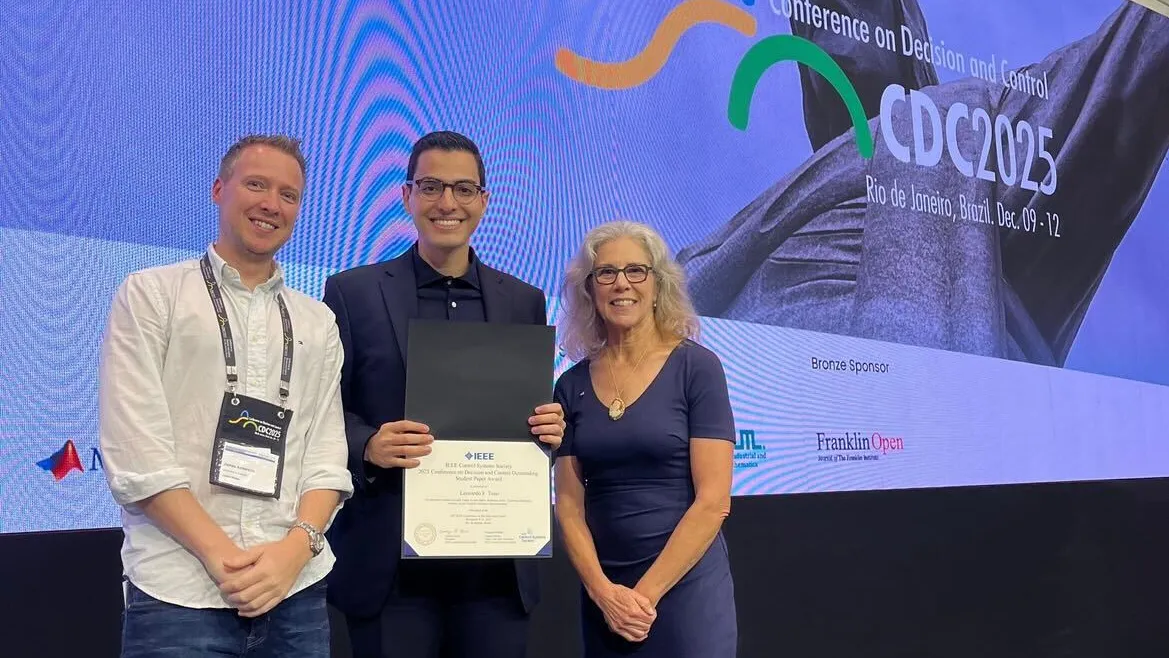
Leonardo Toso, a Ph.D. candidate in the Department of Electrical Engineering at Columbia University, has received the Outstanding Paper Award at the 64th IEEE Conference on Decision and Control (CDC). The award recognizes Toso’s paper, “Learning Stabilizing Policies via an Unstable Subspace Representation,” co-authored with his advisor James Anderson, Associate Professor at Columbia’s Electrical Engineering Department, and Lintao Ye, Associate Professor in the School of Artificial Intelligence and Automation at Huazhong University.
“I am truly honored to receive this award from such an inspiring and influential community,” said Toso. “Being recognized by the control community, one that has shaped both classical and modern foundations of the field, is such a meaningful moment in my Ph.D. journey.”
This work forms a core part of a larger effort the Anderson group at Columbia Electrical Engineering is involved with – bridging the gap between machine learning and feedback control. The paper addresses a fundamental challenge in control: how to design stabilizing controllers for systems that are open-loop unstable when the system model is unknown. While a wide range of classical and modern control techniques exist for stabilizing unstable systems, they typically assume access to an accurate model of the dynamics and operate on the full state space of the system. In contrast, many practical, high-dimensional physical systems, such as aircraft, robotic manipulators, and large-scale safety critical systems, exhibit instability in only a small number of modes, while the remaining dynamics are stable.
Toso’s work introduces a model-free learning approach that focuses control design on the system’s unstable subspace, a low-dimensional representation that captures the dynamics responsible for instability. By restricting policy optimization to this unstable subspace, the proposed approach enables the learning of high-dimensional stabilizing controllers while avoiding unnecessary interaction with stable modes and without requiring explicit knowledge of the system model.
The IEEE Conference on Decision and Control is an annual conference of the IEEE Control Systems Society, bringing together leading researchers from academia and industry to present advances in control, optimization, and learning for dynamical systems. The Outstanding Paper Award highlights work with exceptional technical depth, originality, and potential impact on the field.