A Brief History of Columbia's Department of Electrical Engineering - References
Electrical Science
The term electrical science was coined by Michael Idvorsky Pupin, a professor in the newly established department, in his autobiography. Referring to the claims of other scientific departments about the field, he states, "Crocker and I maintained that there is an 'electrical science' which is the real soul of electrical engineering." That emphasis on scientific foundation continues at Columbia to this day.
Source:
Francis Bacon Crocker
Crocker was a Columbia graduate; the wide-ranging education he received broadened his professional outlook. After a stint in the industry, during which he co- founded the Crocker-Wheeler Electric Motor Company, he returned to Columbia as a Professor. He combined his technical work with activities in electrical engineering professional organizations. He was an early president of the American Institute of Electrical Engineers (AIEE). Because of his industrial experience he understood keenly the role of standards in the growing field of electrical equipment and chaired AIEE’s first industrial standards committee. According to Thomas Edison, “[Crocker’s] painstaking work earned the lasting gratitude of every one connected with the industry throughout the world”. Lord Kelvin called Crocker “one of the world’s two greatest electrical engineers”.
Source:
Michael Idvorsky Pupin
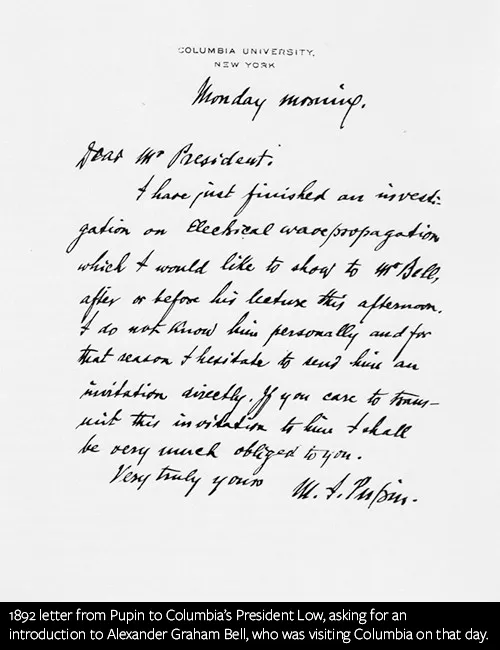
Pupin, the second, and, initially, junior faculty member, represented another important contribution to electrical engineering—he was a physicist who was inspired by both fundamental science and practical invention. Pupin was also the first of a long line of immigrant scholars who have contributed immensely to Columbia's vitality and intellectual strength. Pupin arrived penniless in the U.S. from a small Serbian village, graduated from Columbia, and received graduate training in electricity and electromagnetism in England and Germany. He became an early proponent of AC power transmission (placing him at odds with the established interest in DC), and later developed inductively loaded transmission lines, making possible long-distance telephone communications. His efforts to establish the latter are reflected in a letter from Pupin to Columbia President Seth Low requesting an introduction to Alexander Graham Bell, during Bell's visit to the University in 1892. A more detailed letter, also to Low, explains an arrangement with the American Bell Telephone Company for a $1,000 experiment to test Pupin's ideas. Pupin served also as a mentor for the first graduate students—both Edwin Howard Armstrong and John H. Morecroft received their early inspiration from him. Later in his life he played a critical role in starting the National Research Council, as well as in developing medical imaging technology.
Edwin Howard Armstrong
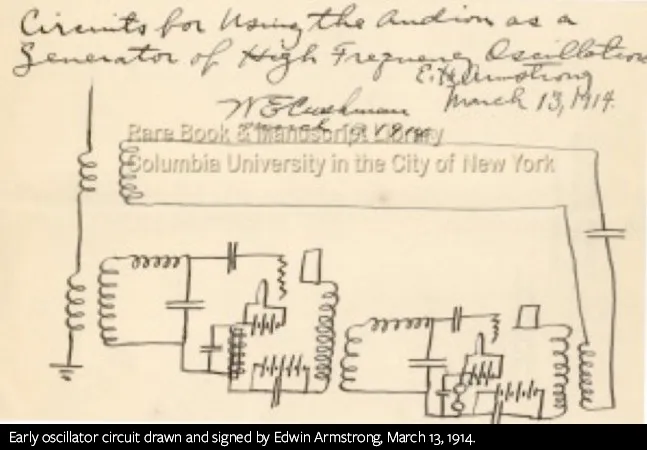
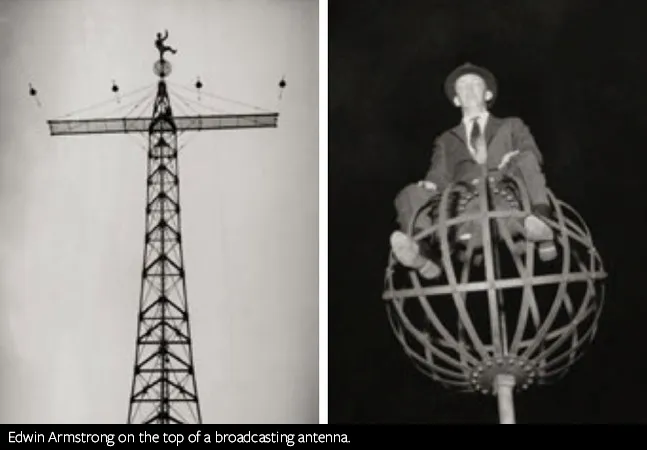
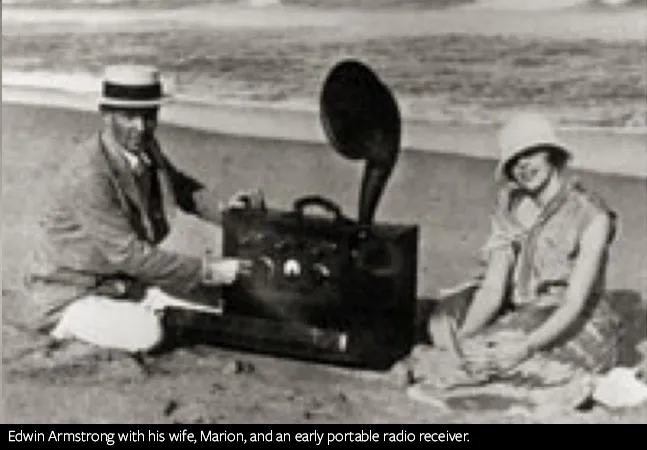
Armstrong worked intensely at his profession throughout his life, starting with the invention of the regenerative detector while still an undergraduate student, continuing with the super-regenerative and super-heterodyne circuits and wideband FM radio, and ending with FM multiplexing a few months before his death in 1954. During his lifetime he won many awards and numerous honorary degrees. The importance of his work drew him into contact with the other giants of radio and electronics, and, as may be expected, some of these interactions developed into rivalries, which spurred the profession but ultimately hurt Armstrong personally. Armstrong was also a dedicated, civic-minded individual who aided the United States in both world wars. He was honored by both the American and French governments for these contributions.
The list of Armstrong's major honors is long and includes the Medal of Honor from the Institute of Radio Engineering, 1917; the Chevalier de la Legion d'Honneur in 1919 from the French government; the first-ever Armstrong Award from the Radio Club of America, named after him to honor his achievements in radio, in 1935; Columbia’s Egleston Medal in 1939; the Holley Medal from the American Society of Mechanical Engineers, 1940; the Franklin Medal from the Franklin Institute, 1941; the Edison Medal from the American Institute of Electrical Engineers, 1942; and in 1947, the Medal for Merit with a presidential citation, the highest civilian award given by the U.S. government.
Sources
- A. M. McMahon, The Making of a Profession: A Century of Electrical Engineering in America, IEEE Press, 1984.
- W. R. MacLauring, Invention and Innovation in the Radio Industry, MacMillan, 1949.
- Special commemorative issue, Electronics Magazine, April 17, 1980.
- New York Section, IRE, Radio Pioneers 1945, commemorative publication.
- Y. Tsividis, “Edwin Armstrong: Pioneer of the Airwaves”, Columbia Magazine, Spring 2002; file:///Users/YannisTsividis%201/Documents/History/Columbia%20EE%20History%20Pr oject/Armstrong/Armstrong.htm
Work During the Wars
Walter Slichter’s chairmanship lasted for over thirty years, from 1910 to 1941. This period included the First World War and the emergence of radio as a communications and entertainment vehicle. The electrification of New York City was completed, and electrically powered industries dominated manufacturing. During the First World War our department played a critical role in giving the United States first-rate electrical technology. Virtually the entire department volunteered to teach at the Navy Submarine School in New London, Conn. Both Crocker and Pupin were senior consultants. Later, Armstrong played a critical role in bringing radio communications to the U.S. Army in France.
Throughout the Slichter era, the department evolved along two dominant technical tracks: electrical motors and power, and radio. Morton Arendt and Slichter, who trained at General Electric under the legendary Charles Steinmetz, were masters of the art of designing and engineering electrical motors, and perhaps could be viewed as Crocker's successors. In radio communications, Armstrong and Morecroft were the dominant forces. Armstrong was the inventor par excellence, but it was Morecroft who first put the technology of radio on paper. In 1921, Morecroft published his groundbreaking book, Principles of Radio Communications. Clearly, this area of departmental interest can be traced directly to Pupin's work. During World War II, when mobile military communications made effective use of Armstrong's FM system, many students in the Navy V-12 program were taught by Columbia electrical engineering faculty, including Arendt, whose inventions over a long, productive career included variable-speed commutating-pole DC motors, storage batteries and other components used in diesel- electric submarine vessels.
Systems and Control
Motivated by the emergence of the digital computer, a group headed by Professor John R. Ragazzini did seminal work on sampled-data systems (now known as “discrete-time systems”) and early digital control into the 1950s.
Professor Ralph J. Schwarz (Ph.D., 1949), later to become vice dean of the School of Engineering and Applied Science, began his affiliation with the department as a student in the 1940s and made major contributions to its activities throughout his career. Among the first group of doctorate recipients during the postwar period, almost all supervised by Ragazzini, were Ralph Schwarz, Lotfi A. Zadeh (Ph.D., 1949), Eliahu Jury (Eng.Sc.D., 1953), Gene Franklin (Eng.Sc.D., 1955), Bernard Friedland (Ph.D., 1957), Rudolph Kalman (Eng.Sc.D., 1957), and Jack Bertram (Ph.D., 1957). Jacob Millman, an expert in electronics, joined the group in 1952.
That period became a veritable golden age of activities in systems and controls at Columbia. Through research publications and textbooks, this faculty group and their doctoral students influenced the development of modern electrical engineering much more than their number would suggest. Much of the classical theory of sampled-data control systems, now known as digital control, was developed at Columbia during the '50s. Jury was a key contributor to the application of z-transform techniques to sampled-data systems; in fact, the name “z-transform” originated at Columbia in 1952. He is also known for the “Jury stability test” for sampled-data systems. Zadeh, today known as the father of fuzzy logic, contributed pioneering work in the area of time-varying systems; in fact, his entire doctoral thesis consists of his seminal paper in that area. Kalman, today known for his landmark work on optimal filtering and control, was a key contributor to state-space methods while at Columbia; he campaigned actively for time-domain techniques, as opposed to the frequency-domain techniques then prevalent in the US. He argued, correctly, that time-domain techniques can easily be extended to nonlinear systems, whereas frequency-domain ones cannot. With his Columbia classmate, Jack Bertram, he originated the fundamental concept of controllability in systems theory.
Pioneering textbooks by Millman in electronics; by Ragazzini, Gene F. Franklin and Jury in sampled-data controls; and by Schwarz and Bernard Friedland in linear systems, made the work of this group known throughout the world.
Sources
- B. Friedland, Control System Design – An Introduction to State-Space Methods, McGraw-Hill, 1985.
- B. Friedland, private communication.
- K. Premaratne, Eliahu I. Jury, IEEE Control Systems Magazine, February 2010, pp. 72- 77.
The Operational Amplifier
The history of operational amplifier (op amp) development at Columbia is a little unusual. Our department had hired John Ragazzini as a faculty member during WWII; he had obtained his PhD from Columbia in 1941, the year the United States entered WWII. Ragazzini created a group that became very well-known for its work on control systems. One of the activities of the group, under a contract from the National Defense Research Council, involved analog computers, a main application of which at the time was in “gun directors” – systems that perform real-time computations for automatically aiming anti-aircraft guns. At the time, high-gain circuits were used for this purpose, notably at Bell Laboratories, as part of negative feedback systems. But those systems were too slow, bulky, and power-hungry.
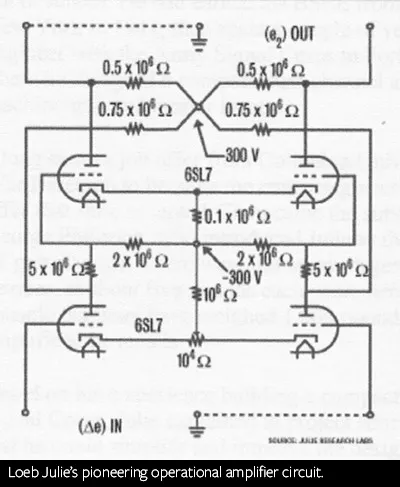
Enter Loebe Julie, a young engineer hired by Ragazzini, who had graduated from New York’s City College and had spent some time with the Army Signals Corp. He proposed to develop smaller, must faster high-gain circuits, with a “differential” input (a + input and a – input) – a feature that later became key to the success of op amps. For reasons that are not clear, Ragazzini did not want Julie to work on this problem. But George Philbrick, a physicist from MIT who was looking to subcontract part of the work he was doing for the National Defense Research Council, visited Columbia and had a talk with Julie, who explained his idea to him. Impressed, Philbrick asked Julie how long it would take for him to develop this idea. Julie said he would need one month. With that, Philbrick asked Ragazzini to allow Julie to work on this project. He did, but bitterness between Ragazzini and Julie ensued.
In one month, Julie had a prototype of a high-gain differential amplifier. The circuit was over one hundred times faster than existing circuits, and consumed much less power. Philbrick ordered multiple units that were quickly incorporated into the M-9 Gun Director, and proved to be very successful.
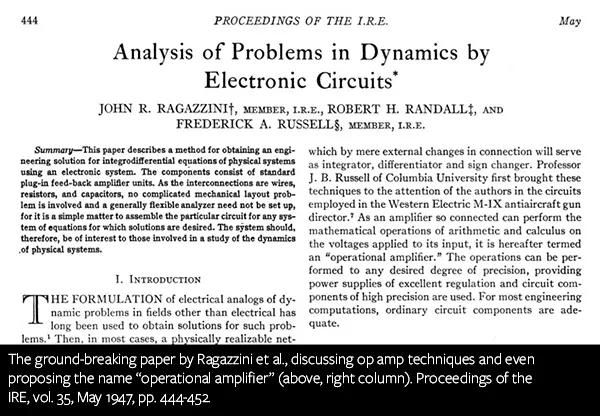
In 1947, Ragazzini and two co-authors, Robert Randall and Fred Russell, published a paper in the Proceedings of the IRE, which was destined to become a classic. Titled “Analysis of Problems in Dynamics by Electronic Circuits”, it proposed the “operational amplifier” name, justifying this name by noting that the circuit, together with other components, can perform mathematical operations. The paper then reviewed several key circuits using op amps. This paper was key to spreading op amp applications, which within a few years became ubiquitous. But Loebe Julie was not a co-author of the paper, and his circuit was not included in it; he is only mentioned in the acknowledgments, for “some phases of this development”. Julie soon left, and later started Julie Research Laboratories, which produced high-precision components and instruments.
George Philbrick founded a company that marketed the first commercial op amp, sparked by Julie’s design, as is acknowledged on the G. A. Philbrick Researches archive. This product was key to getting op amps accepted as electronic building blocks. Op amps can now be found in thousands of products, and some silicon chips contain hundreds of them.
Sources
- J. R. Ragazzini, R. H. Randall, and F. A. Russell, “Analysis of problems in dynamics by electronic circuits”, Proceedings of the IRE, vol. 35, May 1947, pp. 444-452.
- G. Rostky, “Unsung hero pioneered op amp”, EE Times, March 24, 1997; https://www.tayloredge.com/museum/museum/opamp.pdf
- B. Pease, “What’s all this Julie stuff, anyhow?”, Electronic Design, May 3, 1999; https://www.electronicdesign.com/analog/whats-all-julie-stuff-anyhow
- http://www.philbrickarchive.org