

Conclusions
Specifications
The scope of this project encompassed the conception and development of a class-D audio amplifier chip, entailing a comprehensive process spanning from the formulation of system-level specifications to the ultimate testing phase of the integrated circuit (IC) on a customed PCB. Table 1 shows the specifications of the chip.
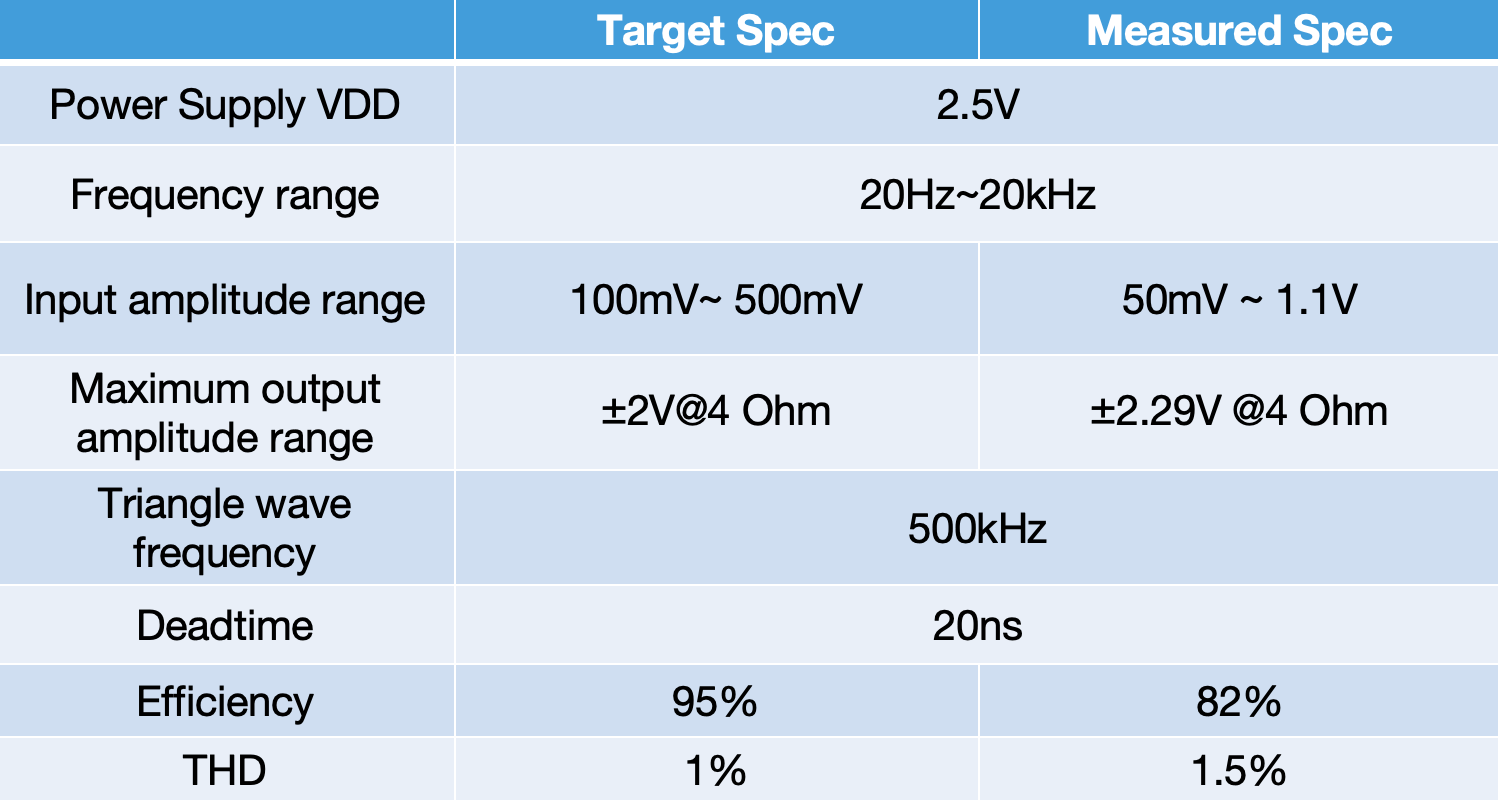
For efficiency, we did not meet the target specification. We are considering two potential reasons that cause this issue. Firstly, when we designed the PCB, we did not put headers after the buck converter and the LDO, which prevented us from measuring the efficiency loss caused by them and thereby lowered our efficiency. Secondly, we detected large offsets in the stages from the tone control OTA to the output of the s2d converter. Although we cancel the offset at the output of the last stage by applying an additional corrective voltage, we cannot cancel the offset of the previous and following stages, which significantly lowers our efficiency.
Acknowledgements
We extend our heartfelt gratitude to Professor Kinget and our TA team for their invaluable support. We have learned enormous knowledge of chip design and gained valuable experience by participating in this course. Special thanks to our TA, Alfred Davidson. Without your guidance and dedicated help, this project would not have reached its successful completion!
Special thanks are due to our generous sponsor, Apple Inc., for providing us with the opportunity to tape out and realize our project goals!
Furthermore, we express our appreciation to another Class D audio amplifier group, "It Takes Two." The seamless communication and collaboration among team members significantly enhanced the efficiency of our work!