

Passive-blind Image Forensic
 Main
Content
People
Publications
Downloads
Links
More Details
Main
Content
People
Publications
Downloads
Links
More Details
Summary
The advent of the modern digital technology has not only brought about the prevalent use of digital images in our daily activities but also the ease of creating image forgeries using publicly accessible and user-friendly image processing tools such as Adobe Photoshop, which currently has 5 million registered users in 2004. One popular form of digital forgeries is photomontage, which is a paste-up produced by sticking together photographic images. The recent well-known photomontage (Figure below) circulated in Internet and published in print materials is one that shows Senator John Kerry, the Democratic presidential candidate potential, sharing a speaker platform with Jane Fonda, the actress and the anti-war activist.
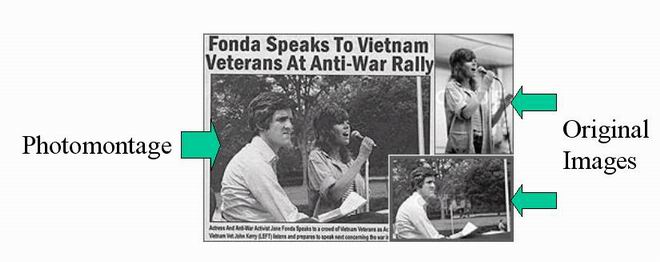
Hence, the need for image authenticity assurance and detection of image forgery such as photomontage has become increasingly acute as digital images become increasingly common as news photographs, legal evidences and digital financial documents.
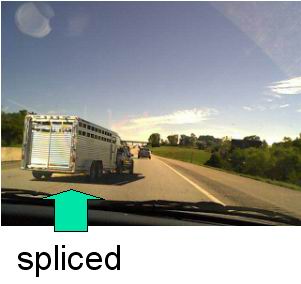
We define image splicing as an operation of sticking together image fragments without further post-processing, e.g. edge softening, etc. Among all operations involved in image photomontage, image splicing can be considered the most fundamental and essential operation. Hence, unlike artifacts given rise by the post-processing operations, the artifact of image splicing is a direct indication of photomontaging. Furthermore, spliced images, as the one shown below, could be of belief-manipulating quality too.
Our goal is to detect spliced images by a passive-blind approach, which can do without any prior information about the image to be authenticated, as well as without the need for embedding of watermark or extraction of image features at the moment of image acquisition. In addition, the ability of detecting splicing without post-processing is fundamental and critical. It can be combined with other techniques for detecting various post-processing artifacts, such as smoothing.
Bicoherence, a third-order moment spectra and an effective technique for detecting quadratic phase coupling (QPC), has been previously proposed for passive-blind detection of human speech splicing, based on the assumption that human speech signal is low in QPC. For ideal signals with Gaussian statistical characteristics, the third-order moment spectra is zero. Therefore, higher-order moment spectra have been proposed as potential features verifying the authenticity of signals. However, images are shown to originally have non-trivial level of bispectrum energy which implies an originally significant level of QPC. Hence, we believe that straightforward applications of bicoherence features for detecting image splicing would not be effective.
We propose two unique directions to augment the use of higher-order image statistics. First, we incorporate the effect of image content (such as edge pixel percentage) on the higher-order statistics. We found the bicoherence feature distributions of authentic and spliced class becomes more overlapped when the edge percentage in the image block increases. Second, we apply image decomposition techniques (e.g., decomposition to structure and fine texture), assuming the main difference between a spliced image and its authentic counterpart resides in the fine texture component.
In addition, we have developed a theoretical foundation to model the spliced signal artifact (as bipolar perturbations) and explained the effect of splicing on the bicoherence feature.
For more technical
details, please go to the  detailed research description
page
detailed research description
page  .
.
Our contributions are:
-
Proposing two general methods for improving the performance of using bicoherence features for passive-blind image splicing detection.
-
Proposing a model of image splicing to explain the effectiveness of bicoherence for image-splicing detection.
-
Creating a benchmark data set which contains 933 authentic and 912 spliced image blocks of 128x128 pixels, using images from Calphotos and images captured by us.
Data Set
We have created the Columbia Image Splicing Detection Evaluation Dataset for evaluating the performance of blind passive image authentification algorithms. The Columbia Image Splicing Detection Evaluation Dataset is a dataset open for download.
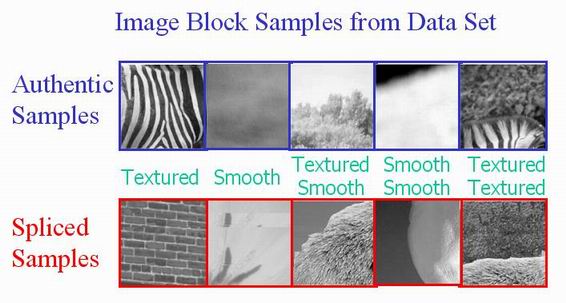
There are 5 types
of image blocks respectively for the authentic and the spliced classes,
as shown in the figure below. Spliced image blocks are obtained by either
orbitrary-object-shaped splicing or straight line splicing. The sources
images are from the
CalPhotos collection
as well as some captured by us. For more information, please refer the
technical report describing the data set, listed in the publication section
below.
Improvement on separability of Authentic and Spliced Image Blocks
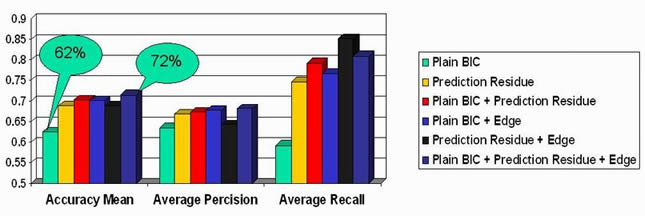
The plain bicoherence magnitude and phase features achieve only 62% of classification accuracy between the authentic and the spliced image blocks, using Support Vector Machine (SVM).
The features derived from the two proposed methods improve the classification accuracy from 62% to 72% (See figure below). The derived features are the prediction residual for the bicoherence magnitude and phase features and the edge percentage feature. Please refer to the ISCAS 2004 paper, for more details.
A Model for Image Splicing
A simple image splicing model based on bipolar signal perturbation of an authentic signal is proposed. The mathematical form for a bipolar signal is as follows:

The intuition behind the model is that a jagged-edge signal possibly introduced by image splicing could be modeled as bipolar signal perturbation on a smooth signal, as illustrated in the figure below. Authentic image is considered to be a relatively smooth signal because most of the cameras have a optical low-pass filter installed for the reduction of aliasing effect. Low-pass filtering smooth out jagged part of an image.
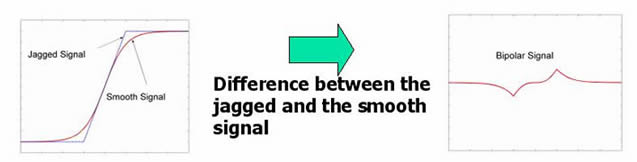
The theoretical analysis shows that image splicing based on this model could induce an increase in the bicoherence magnitude and phase features at certain values (e.g., +90 or -90 degrees). This outcome has been consistent with empirical observations. Please refer to the ICIP 2004 paper, for more details.
People
Publications
Conferences
- Tian-Tsong Ng, Shih-Fu Chang, Jessie Hsu, Lexing Xie, Mao-Pei Tsui.
Physics-Motivated Features for Distinguishing Photographic Images
and Computer Graphics. In ACM Multimedia, Singapore, November 2005.
[Abstract]
[pdf]
[slides]

- Tian-Tsong Ng, Shih-Fu Chang. A Model for Image Splicing. In IEEE International Conference on Image Processing (ICIP), Singapore, October 2004. [Abstract] [pdf] [slides]
- Tian-Tsong Ng, Shih-Fu Chang, Qibin Sun. Blind Detection of Photomontage Using Higher Order Statistics. In IEEE International Symposium on Circuits and Systems (ISCAS), Vancouver, Canada, May 2004. [Abstract] [pdf] [slides]
Technical Reports
- Tian-Tsong Ng, Shih-Fu Chang, Jessie Hsu, Martin Pepeljugoski. Columbia Photographic Images and Photorealistic Computer Graphics Dataset. ADVENT Technical Report #205-2004-5 Columbia University, February 2005. [Abstract] [pdf]
- Tian-Tsong Ng, Shih-Fu Chang. Blind Detection of Digital Photomontage using Higher Order Statistics. ADVENT Technical Report #201-2004-1 Columbia University, June 2004. [Abstract] [pdf]
- Tian-Tsong Ng, Shih-Fu Chang. A Data Set of Authentic and Spliced Image Blocks. ADVENT Technical Report #203-2004-3 Columbia University, June 2004. [Abstract] [pdf]
Downloads
- Columbia Image Splicing Detection Evaluation Dataset
- Columbia
Photographic Images and Photorealistic Computer Graphics Dataset
Demo
Links
-
Detailed research description page
for the Passive-blind Image Splicing Detection Project
-
Columbia Photographic Images and Photorealistic Computer Graphics Dataset

-
Research summary page for
other research projects in
DVMM group
For problems or questions
regarding this web site contact The
Web Master.
Last updated: June 29, 2005.