


For 1-D signals, a basis set corresponds to a tiling of the time-frequency plane [HKRV93]. For images, it corresponds to a partitioning of the joint 4-D space and spatial-frequency space. To generate a basis, the nodes in the library must be selected such that the image can be reconstructed completely and non-redundantly. Using the indexing notation of the time-frequency plane, this requires that nodes should be selected to form the basis  such that

If the nodes do not overlap, this guarantees that the basis is complete by requiring that the time-frequency plane is completely covered by the selected nodes. In order to ensure that the basis is non-redundant - no overlap, each node included in the basis necessarily excludes other nodes. For example, this is illustrated in Figure 11(b). When node  is included in the basis, in order to have no overlap with other nodes, all the darkened nodes must be excluded from the basis. This requires that,

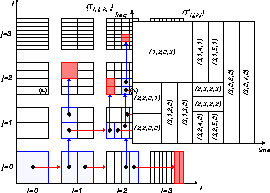
Figure 12: (a) Basis selection from dyadic time/frequency library, (b) corresponding time/frequency tiling.
The restrictions on node membership in a basis can be translated into equivalent requirements on the graph. Any basis, or complete and non-redundant tiling of the time-frequency plane, corresponds to the set of terminal nodes of an embedded graph. For example, Figure 12(a) indicates a selection of nodes from the library that give the tiling of the time-frequency plane in Figure 12(b). Notice that the full graph has been pruned to produce the graph in Figure 12(a). The light shaded nodes are intermediate nodes in the pruned graph, the dark nodes are the terminal nodes and the unshaded nodes have been pruned from the graph. We also point out that the basis shown in Figure 12 is not accessible from either the wavelet packet tree, the spatial quad-tree, the double tree or the dual double tree. The completeness and non-redundancy requirements correspond to a recursive selection at each node, starting from the root node, of either (1) termination, (2) frequency branching or (3) segmentation.