


There are two notions of libraries in the signal expansion: (1) the library of orthonormal basis functions utilized in the full wavelet packet expansion, as discussed earlier, and (2) the library consisting of all the nodes in space and frequency graph. In order to select the nodes from the space/spatial-frequency library that best represent the image, the nodes must be accessed, analyzed and compared. For one, each node in the graph can be indexed by its graph position. Alternatively, since each node represents a region in space and spatial-frequency, a node can also be indexed using a description of the region. For example, in the 1-D version of the graph - the joint time-frequency graph, a four-index transform of the 1-D signal is produced. Each node represents a region in the time-frequency plane that can be indexed by four parameters: i = time resolution, j = frequency resolution, k = position in time and l = position in frequency. The time-frequency library and the embedded graph is shown in Figure 11(a). For 2-D signals, the expansion similarly implements an eight-index transform, which includes x and y directions in space and spatial-frequency.
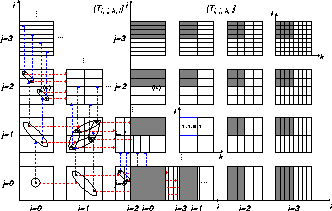
Figure 11: Time-frequency library, (a) connectivity provided by time-frequency graph, (b) selection of node  excludes all darkened nodes from the basis.