
Self Assembly and Molecular Computing
Advances in chemical synthesis have laid the groundwork for computation at nanoscale, where self assembly becomes the core process, either as a computation itself, or as a mechanism for fabricating nanodevices. By such processes, elementary particles, such as DNA molecules, perform computations
by assembling autonomously into large complexes following built-in bonding rules. The MASA group studies self assembly viewed as a random growth process, addressing such as questions as:``How long does the structure corresponding to a given computation take to self-assemble?'' ``How does one optimize the yield of a self-assembly process?'' ``What are the trade-offs between the reliability (error tolerance) and speed of self assembly?'' Answers to these questions bring out unexpected connections with classical areas of mathematics .
The outline of a tutorial to be given at Performance 2007 can be found in
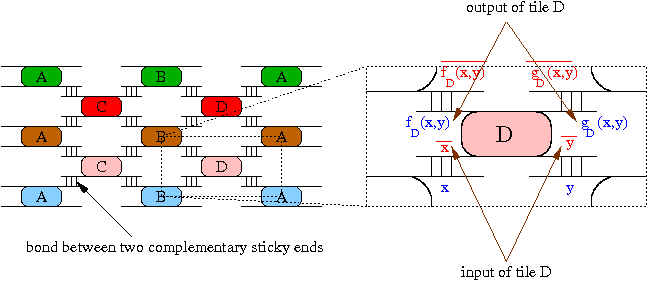
Figure 1. Tile Assembly.
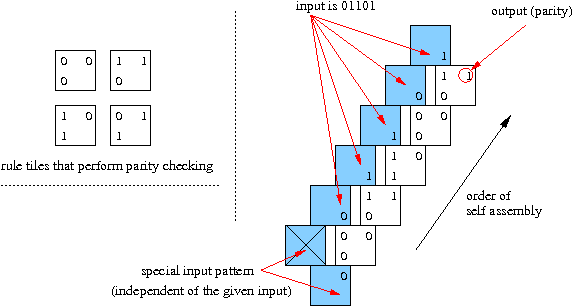
Figure 2. Parity.
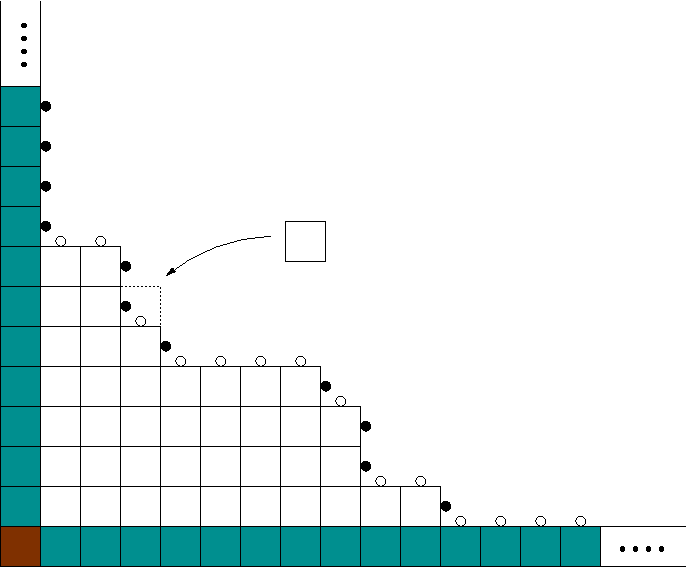
Figure 3. Generating Tape.