Research
Economics of the Internet
The Internet is composed of thousands of network systems operated by autonomous Internet Service Providers (ISPs). ISPs have to interconnect to and interact with each other to provide Internet services for their customers. Due to the selfish profit-seeking nature of the ISPs, the cooperation among ISPs does not happen voluntarily. In fact, various selfish behaviors encumber the cooperation and induce multiple consequences on the Internet.Problems
The Selfish Routing Problem
ISPs can make routing decisions by forwarding packets to different neighboring ISPs. Instead of choosing the best path to forward packets, ISPs make choose the least costly routing path to traverse inside its own network. This is often done by using "hot-potato" routing which always forward packets through the nearest egress point to save routing costs. These selfish routing behaviors make the Internet extremely inefficient.The ISP De-peering Problem
Decades ago, ISPs were homogenous and the traffic pattern was symmetric. They used to interconnect with each other by zero-dollar peering agreements. However, today's ISPs differ dramatically by their characteristics. For example, we can classify ISPs into three categories by the customers they serve: 1) eyeball ISPs that serve individual home-users to get Internet access, 2) content ISPs that serve content providers like Google/Yahoo and Content Distribution Networks (CDNs) like Arkamia, and 3) transit ISPs that serve other ISPs for transit services. ISPs start to charge each other, but not all ISPs are willing to pay what the other party charges. In Oct. 2005, one of the largestest transit ISPs LEVEL 3 unilaterally disconnected all peering links with another transit ISP Cogent, resulting at least 15% of the Internet unreachable for the customers of both ISPs at that time. Without an appropriate compensation structure, ISPs don't have incentive to cooperate by interconnecting and the Internet will start to Balkanize.- The Network Neutrality Debate
Another unsolved problem that hinders the development of the Internet is the debate of network neutrality, which argues whether service differentiations should be provided for Internet services. Eyeball ISPs and transit ISPs support for providing differentiated services, since they want to recoup their investment through differentiated prices. However, content providers advocate the neutrality of the network, which prohibits the discriminations on delivering different contents on the network. They worry about the market power of the incumbent ISPs and their ability to extract profit. Again, without an appropriate compensation structure for the ISPs to share profits, it's difficulty for all ISPs to cooperate and provide better services for customers.
Solutions
The Shapley Value Solution
Proposed by Lloyd Shapley, the Shapley value solution can be used to share profit among a group of cooperative entities. This solution satisfies multiple desirable properties. We introduce three desirable properties that uniquely define the Shapley value solution. We use the following simple example to explain. For a simplified PC industry, we have Microsoft that produces the operating system, i.e. Windows, and Intel and AMD that produce micro-processors. Suppose the profit V from the industry is the total revenue minus the total cost incurred in all firms. The Shapley value solution tells what is the appropriate profit sharing solution for all three firms.- Efficiency Property: The profit of all three firms should sum up to V.
- Symmetry Property: The two symmetric processor producer should obtain the same amount of profit.
- Fairness Property: For any pair of firms, their marginal contribution to each other should be the same.
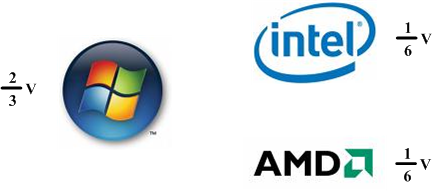
The Shapley value suggests that the unique solution satisfying all above three properties is to give Microsoft 2/3 of the total profit, and 1/6 for both AMD and Intel. By checking the balanced contribution property, we know that without the help of Intel, Microsoft had to evenly share profit with AMD, so the marginal profit is 2/3 - 1/2 = 1/6. It is also the marginal profit Microsoft provides to Intel, because without Microsoft, both processor makers will earn zero profit.
- The Shapley Mechanism
Given any static settings of a market structure, we can find the ideal Shapley value profit sharing solutions for all participating entities. We consider the Internet as a group of cooperative ISPs generating profits by serving customers. Each ISP can make selfish decisions on routing and interconnecting. We explore the behaviors of the ISPs and the evolution of the Internet under the policy where a Shapley value profit-sharing is enforced.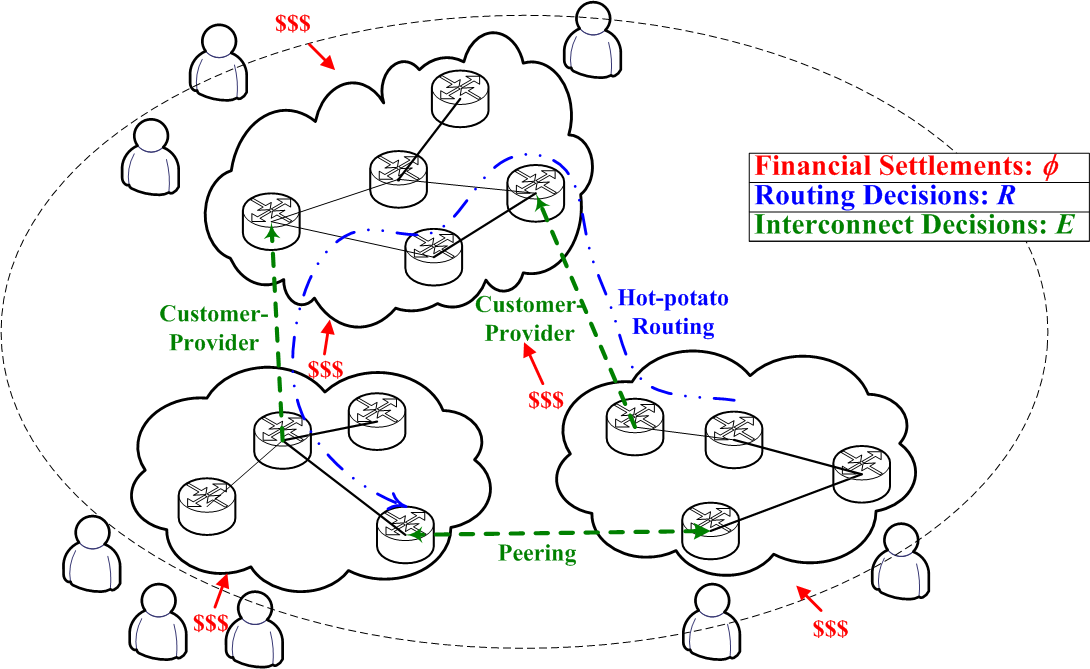
From the figure above, we can enforce a financial settlement mechanism based on the Shapley value solution. Each individual ISPs make various selfish decisions, including routing and interconnecting decision. We have shown that the whole Internet will evolve to converge to a Nash equilibrium where the social welfare is maximized and the global cost is minimized. This means that under the Shapley value mechanism, each ISP's individual profit objective coincides with the global optimality of the Internet.
References
-
Richard T.B. Ma, Dah Ming Chiu, John C.S. Lui, Vishal Misra and Dan Rubenstein.
Internet Economics: The use of Shapley value for ISP settlement.
IEEE/ACM Transactions on Networking, Volume 18, Issue 3, June 2010. -
Richard T.B. Ma, Dah Ming Chiu, John C.S. Lui, Vishal Misra and Dan Rubenstein.
On Cooperative Settlement Between Content, Transit and Eyeball Internet Service Providers. [Presentation Slides]
Proceedings of ACM Conference on Emerging network experiment and technology (CoNEXT 2008), Madrid, Spain, December, 2008. -
Richard T.B. Ma, Dah Ming Chiu, John C.S. Lui, Vishal Misra and Dan Rubenstein.
Interconnecting Eyeballs to Content: A Shapley Value Perspective on ISP Peering and Settlement. [Presentation Slides]
Proceedings of ACM Network Economics (NetEcon '08), Seattle, August, 2008. -
Richard T.B. Ma, Dah Ming Chiu, John C.S. Lui, Vishal Misra and Dan Rubenstein.
Internet Economics: The use of Shapley value for ISP settlement. [Presentation Slides]
Proceedings of ACM Conference on Emerging network experiment and technology (CoNEXT 2007), New York, USA, December, 2007.