


There are two classes of techniques for color indexing: indexing by (1) global color distribution and (2) local or region color. An important distinction between these techniques is that indexing by global distribution enables only whole images to be compared while regional indexing enables matching between localized regions within images. Both techniques are very useful for retrieval of images and videos but are suited for different types of queries.
Color indexing by global distribution is most useful when user provides a sample image for the query. For example, if the user is interested in finding panoramic shots of a football game between two teams, then by providing one sample of the image others can be found that match the query image. Color indexing by global color distribution works well in this case because the user is not concerned with the positions of colored objects or regions in the images. However, when the user is interested in finding things within images the global color distribution does not provide the means for resolving the spatially localized color regions from the global distribution.
On the other hand, color indexing by localized or regional color provides for partial or sub-image matching between images. For example, if the user is interested in finding all images of sunsets where the sun is setting in the upper left part of the image, then regional indexing enables this query to be answered. Localized or regional color indexing is generally more difficult because it requires the effective extraction and representation of local regions. In both cases a system is needed for the automated extraction and efficient representation of color so that the query system provides for effective image and video retrieval. In this paper we present a technique that applies to both global and localized color region extraction and indexing.
The feature extraction system consists of two stages: (1) extraction of regions and (2) extraction of region properties as shown in Figure 1. An automated system performs both stages without human assistance. It is typically stage 1 that is either manual or semi-automatic when the system is not fully automated. The representation of region color is often more robust when the region extraction is not automated.
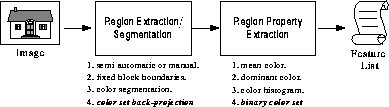
Figure 1: General approach for color image feature extraction.