


By looking more closely at the series of branchings in the full space and frequency tree, Figure 9(b), we see that we can reduce the tree into an equivalent graph structure [SC95]. The payoff comes from recognizing commutativity in F and S branchings. As mentioned above, the filter bank and segmentations may be arbitrarily cascaded and perfect reconstruction is maintained even if the synthesis path has a different order than the analysis path. This commutativity is provided by using the overlap-add method in synthesis filtering. This observation can be used to greatly reduce the size and complexity of the joint expansion. The full adaptive tree contains many redundant nodes. Since the output of the  cascade is equivalent to the output of the
  cascade, the data does not need to be produced twice. As illustrated for the image in Figure 9(b), the set of children generated from the cascade is the same as that in the cascade, but the order is different. When the full adaptive tree is modified to collect the redundant nodes, the space and frequency graph structure is produced, see Figure 10(a). Inspection reveals that the double tree, Figure 8(a), the dual double tree, Figure 8(b), and the space and frequency graph, Figure 10(a), have identical nodes, but with different connectivity. The space and frequency graph offers the maximum connectivity between nodes.
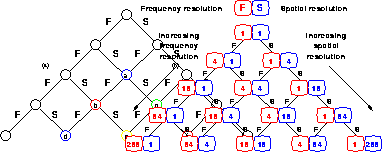
Figure 10: (a) space and frequency graph, (b) Space and frequency resolution trade-off with graph depth.