


 )
)Filtering and segmentation may be cascaded such that the orders within the analysis and synthesis cascades are different. This case do not guarantee that the perfect reconstruction property of the system is preserved unless careful consideration is made for the border extension used for filtering operations. But first, consider the filter bank that includes the segmentation of the subbands, as illustrated in Figure 4.
In certain cases the filter operations do not require border extension. For example, when F implements a block transform, i.e., Haar filter bank, border extension is not necessary. In this case, the overall system maintains perfect reconstruction as follows: in the cascaded filter bank, synthesis filtering is applied to the segmented subbands, and the outputs are summed to reconstruct the signal. The analysis section consists of the cascade  where
where

The synthesis section,  , gives the reconstructed signal by

Since  ,
,

which is the same expression for the two channel perfect reconstruction filter bank shown previously. Therefore, a block transform and segmentation cascade system preserves the perfect reconstruction property of the filter bank.
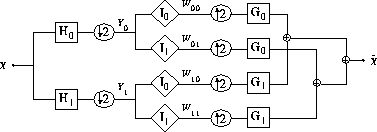
Figure 4: Perfect reconstruction filter bank incorporating segmentation of subbands, analysis filters  , complete and disjoint indicator functions
  , and synthesis filters
  , where
  .
.
In the more general case, the filters and have length  . Since the signal input into each filter is finite, say length N, the convolution produces an output signal of length L = M + N - 1. This increases the amount of signal data, which is undesirable in the application of image compression. To alleviate this problem, a finite length input signal is extended at its borders by M/2-1 data points, and the filter output is truncated to N points [KV89]. To minimize the distortion resulting from border extension, the same extension rule is used for both synthesis and analysis filtering. However, in the case of the filter bank of Figure 4, each synthesis filtering operation does not correspond to one analysis filtering operation. As a result, there is no simple solution for matching the synthesis and analysis border extension. For example, in Figure 4, the extended data for
  is different from the extended data for the input X. Using the same extension rule generates different extended border data for and X, which degrades the reconstruction property of the filter bank.
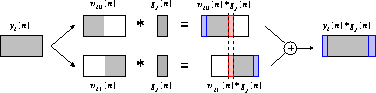
Figure 5: Overlap-add method of signal convolution using independent convolution of sections of the signal.
Therefore, we propose an alternate solution for border extension for synthesis filtering. This includes both matching synthesis border extension to that of analysis filtering and using border extension with zeros. The technique is related to the overlap-add method of obtaining a linear convolution with an infinite length signal [OS75][VK95]. Using overlap-add, the signal is broken up into non-overlapping sections and each is extended at its borders with zeros. When each section is filtered, the output data expands by M-1, where M is the filter length. The outputs of filtering all the sections are then realigned such that they overlap with neighboring sections by a total of M-1 data points. By summing these sections together, the effect of breaking the signal into segments before filtering is eliminated. This is illustrated in Figure 5, and is formulated as follows: let each segment of  have only N nonzero points, then segment
  can be expressed as,

Then  is equal to the sum of the
  and is given by
  , for K segments. Then the convolution of with
  is equal to the sum of the
  convolved with , as desired,

By using overlap-add in synthesis filtering, the effect of segmenting the subbands is eliminated. However, since the original input signal, x[n], is of finite length, overlap-add is used only on segment borders that correspond to the interior of x[n]. When the border of a segment coincides with a border of the unsegmented signal, the extension is matched to that used for analysis filtering.
This completes the description of the building blocks of the adaptive signal expansion. The two-channel filter bank is used to produce the orthonormal signal expansion and the segmentation bank divides its input into non-overlapping and complete sections. Filtering and segmentation can be arbitrarily cascaded in the analysis and synthesis systems. When the overlap-add rule is used for synthesis, the cascade orders of the analysis and synthesis do not need to match in order to maintain perfect reconstruction. This was shown for the two-channel filter bank with binary segmentation system above. Armed with these powerful operators, we now construct a system for the arbitrary and adaptive image expansion that includes decomposition in both space and spatial-frequency.