<< Back to main page
E6820 Assignment 2
Reading assignment
Paper:
“Physical Modeling using Digital
Waveguides,” Julius O. Smith III, adapted from
Computer Music Journal
16:74-87, 1992
Summary:
This is a difficult paper to summarize because it covers a lot
of ground. Smith first describes the basics of traveling waves
and sampling. Smith then points out that position is not the
only traveling wave you can model. There are also time derivative
waves (velocity and acceleration), spatial derivative waves (slopes and
curvature), force waves, power waves, and energy density waves.
Each of these waves may be more or less applicable to a
particular simulation.
Moving away from an ideal string, Smith discusses simulating energy
loss and rigid terminations. He then finishes off with some more
specific information on simulating a plucked string, a struck string, a
single reed instrument, and a bowed string.
Thoughts:
One of the things Smith emphasizes is that by consolidating
losses, the system has many fewer multiplies, which are expensive.
Now, reducing the number of computations is always good, but I
wonder if it is so much of an issue today. The paper was written
in 1992, when the world had a lot less computing power. Of
course, Smith also points out that fewer multiplies also means fewer
rounding errors, which is clearly still valid today.
I see that this paper is from the Computer Music Journal
and I wonder who reads it. Smith went over certain information
that you'd expect engineers to know. For example, he tells us
that the z^(-1) symbol indicates a one sample delay. So, I'm
guessing that the journal is read by people who may not have the
technical background that electrical engineers have.
Practical assignment
pluck1a.m - digital waveguides in action
Changing "len":
The variable "len" controls the pitch. In particular, len
= 50 produced a sound that was one octave below len = 25.
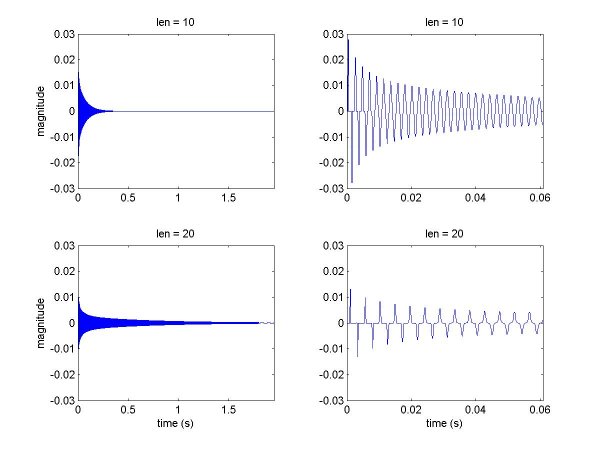
Changing "len" also seems to affect the magnitude of the onset
and the decay. I ran the simulation with len = 10 and len = 20
(see images below). The lower value for "len" produced a stronger
onset and a sharper decay. For the time scale, I assumed a
sampling rate of 8192, which is the default for soundsc.
Changing "r":
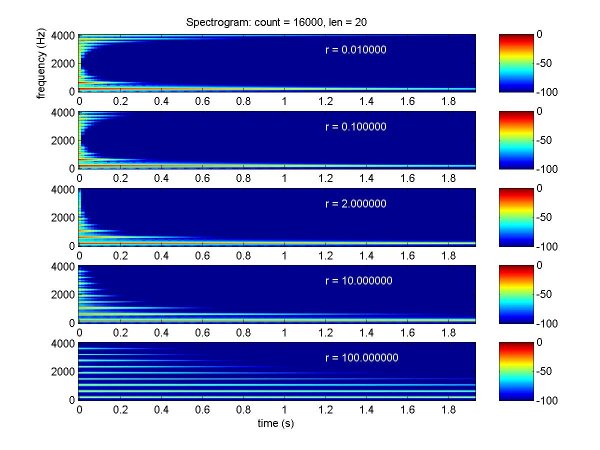
Changing "r" seems to change the timbre of the sound. Note
the spectrograms below for different values of 'r'. For really
small values of r, like 0.01, there is an odd high-pitched ring.
It almost sounds like two pitches instead of one. The
spectrograms bear out this impression. For r = 0.01, the sound
has quite a lot of high frequency content. Values larger than 2
make the sound richer. As r gets larger, more partials are
sustained for longer periods of time.
Project
Work on the project can be found on my project page here.
Christine Smit
