 Aurel A. Lazar (Fellow, IEEE), is Professor
of Electrical Engineering at Columbia University.
Aurel A. Lazar (Fellow, IEEE), is Professor
of Electrical Engineering at Columbia University.
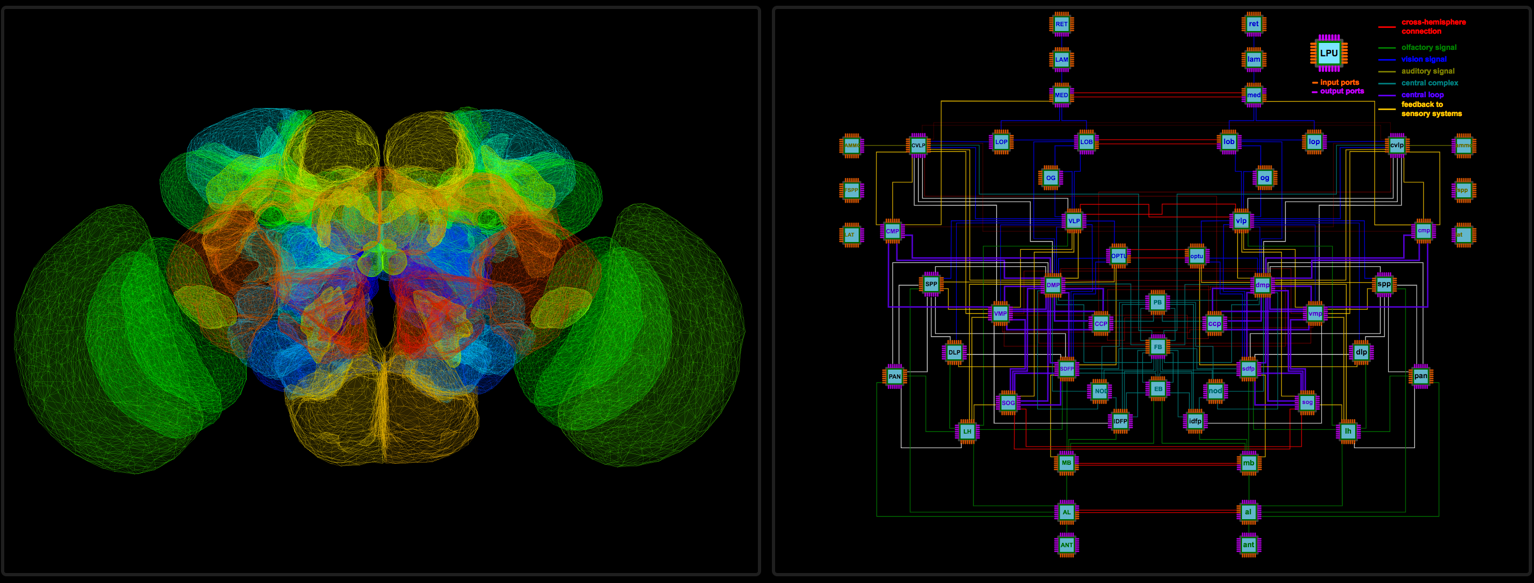
My primary research interests focus on the molecular architecture and functional logic of the brains of model organisms with a strong emphasis on the fruit fly brain. I lead three research projects: Building Interactive Computing Tools for the Fruit Fly Brain Observatory, Computing with Fruit Fly Brain Circuits and Creating NeuroInformation Processing Machines.
The Building Interactive Computing Tools for the Fruit Fly Brain Observatory project develops interactive computing tools for the exploration and visualization of fruit fly brain connectomic and synaptomic datasets within the transformative, open, collaborative Fruit Fly Brain Observatory ecosystem that my research group pioneered. The project is developing BrainMapsViz, a suite of state-of-the-art web applications supporting the exploration of fruit fly brain connectomic/synaptomic datasets, and FlyBrainLab, a one-stop interactive computing platform for studying the function and biological validation of executable circuits constructed from fly brain data.
The Computing with Fruit Fly Brain Circuits project explores the molecular architecture and executable models of fly brain circuits and local processing units. The project advances a key thesis: that a small family of computational primitives -- differential, spatio-temporal Divisive Normalization Processors (DNPs) -- can be modeled from the connectome, composed into executable cascades that factor sensory input into object identity ("semantics") and object dynamics ("syntactics"), and validated across neurophysiology datasets, developmental stages, and modalities. Some of the main ongoing foci address The Graph Structure of the Connectome and Synaptome Datasets, The Functional Logic of the Odor Information Processing Circuits, The Functional Logic of the Visual Information Processing Circuits and The Functional Role of the Central Complex of the Fruit Fly Brain.
The Creating NeuroInformation Processing Machines project builds upon my early neuro- computing work, which pioneered the lossless representation of auditory scenes and visual fields in the spike domain (Audio/Video Time Encoding Machines) and the functional identi- fication of neural circuits in the early auditory and vision systems (Channel Identification Machines). This work formally established the mathematical duality between neural decoding and system identification. My research group also created and implemented Phase Processing Machines in the analog domain (graded potentials) and Spike Processing Machines in the spike domain on GPU clusters.
Prior to my research in computational and systems neuroscience, I spent roughly 20 years as PI of several computer networking research groups. I covered a broad set of research topics and fields, including building major switching hardware, architecting broadband kernels for programmable networks, pioneering the xbind open programmable network, creating game-theoretic models of resource allocation and auction mechanisms in multi-user communication networks, and modeling heavy-tailed network traffic. I also ran a networking start-up as CEO.