


The color set representation is defined as follows: given the color triple (r,g,b) in the 3-D RGB color space and the transform T between RGB and a generic color space denoted XYZ, for each (r,g,b) let the triple (x,y,z) represent the transformed color such that

Let  be a vector quantizer function that maps a triple (x, y, z) to one of M bins. Then m, where
  , is the index of color (x, y, z) assigned by the quantizer function and is given by

Let  be an M dimensional binary space that corresponds to the index produced by such that each index value m corresponds to one axis in .

For example, let T transform RGB to HSV and let where M=8 vector quantize the HSV color space to 2 hues, 2 saturations and 2 values. assigns a unique index m to each quantized HSV color. Then  is the 8-dimensional binary space whereby each axis in corresponds one of the quantized HSV colors. Then a color set
  contains a selection from the 8 colors. If the color set corresponds to a unit length binary vector then one color is selected. If a color set has more than one non-zero value then several colors are selected. For example, the color set
  corresponds to the selection of three colors, m=7, m=4 and m=2, from the quantized HSV color space.
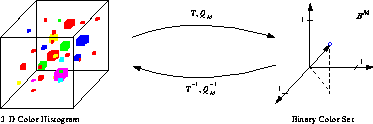
Figure 4: Transformation between 3-D color histogram and binary color set.