
|
|
|
|
|||
|
|
|
|
|
||
|
|
|
|
|
||
|
|
|
|
|
||
|
|
|
|
|||
|
|
|
|
|||






|
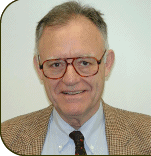
This page describes Prof. Coffman's employment
history (institutions are in boldface), along with brief statements of responsibilities and research
directions in general terms. PhD graduate students are also listed
where appropriate. Discussions of his research contributions to-date and a
research biography in greater depth are given in the RESEARCH section. PROFESSIONAL POSITIONS 1958-1966: After an undergraduate degree
in Mathematics (UCLA '56) and two years of active duty in the U.S. Navy, Lieutenant(j.g.) Coffman
simultaneously began part-time graduate studies at
the University of California at Los Angeles (UCLA) and a full-time
systems programmer position at a non-profit spin-off of the RAND Corporation:
the System Development Corporation (SDC), where for 3 years he taught
machine architecture, elementary algorithms, and assembly language programming. This work moved him
first into operating systems development, particularly time-sharing systems and computer networks,
and then performance modeling and analysis. His later work at SDC merged with his
graduate research at UCLA: stochastic modeling and analysis of computer
systems - research results at the former were collected in a dissertation at the
latter, whence the Ph.D. degree in 1966.
1966-1970: Coffman went on to the
Electrical Engineering Department of Princeton University, where his research
interests expanded into data structures, algorithmics, and combinatorial
scheduling theory. He was the PhD. advisor of R. Muntz, A. Shoshani, M.
Schmookler, and G. Burnett. He taught classical Electrical Engineering (circuit
theory, switching theory, ...) and early Computer Science (algorithms, formal languages and
automata, ...). He also had a visiting position at Brooklyn Polytechnic Institute,
now the Polytechnic Institute of New York University. 1969-1970: His last year on the Princeton
faculty was spent on leave at the (UK) Universities of Newcastle-upon-Tyne
and Durham, where he was a Visiting Professor supported by an IBM Fellowship.
His was a research brief only, and pursued directions already established. 1970-1976: Coffman joined the Computer
Science Department of the Pennsylvania State University (PSU) in 1970 where his
research interests in bin-packing theory and average-case analysis of
scheduling algorithms had their beginnings. He started as an associate
professor and was promoted to full professor a couple of years later. His
PhD advisees at Penn State were J. Michel, R. Cody, and J. Leung. He was
acting head for one term, and his
teaching focused on the design and analysis of algorithms, and on operating
systems. 1974-1975: He spent a year on leave from
PSU at research in E. Gelenbe's equipe at the Institut National de
Recherche en Informatique et en Automatique (INRIA) in Rocquencourt, a suburb of Paris. INRIA,
which in those days was just IRIA, had only just been created. The
principal direction of his research there was performance modeling and
analysis of computer systems. 1976-1977: In a return to electrical
engineering, Coffman spent a brief one-year tour of duty at Columbia
University, where he connected with Kimming So, a Ph.D. advisee, and began
research into the average-case analysis of bin packing. 1977-1979: Coffman went on to the
Department of Electrical Engineering and Computer Science at the University
of California, Santa Barbara in 1977 and was accompanied by Kimming So who
completed his PhD degree there in 1978. Coffman's research in two
dimensional packing began in Santa Barbara. 1979-1999: Coffman spent 20 years in the Mathematics Research
Center of Bell Laboratories, more specifically in a department devoted
primarily to the mathematical foundations of computer science and operations
research, a department led successively by R. Graham, M. Garey, D.
S. Johnson, and P. Winkler. He continued his
research in bin packing and scheduling theory, and in the average-case
analysis of algorithms; he began his research in moving-server problems,
dynamic storage allocation, stochastic scheduling, interval packing problems (also
known as space
filling, adsorption-desorption, and parking problems), reservation theory,
polling systems, and in the performance analysis of
networks. 1999-2000: In 1999, Coffman retired
from Bell Labs and accepted
positions of Foundation Professor in the Computer Science Department and Associate Dean for
Computing at the New Jersey Institute of Technology. He taught a course in
algorithms and one in advances in communication networks. 2000-2008: Coffman closed a 23-year cycle by
returning in 2000 to his old position in the Electrical Engineering Department of
Columbia University. He also had positions (nonbudgeted appointments) in the Computer
Science Department and in the Department of Industrial Engineering and
Operations Research.
He taught courses in applied probability, communication systems
and networks, performance evaluation of computer and communication systems,
and an advanced course in the analysis of algorithms. His
recent research has focused on scheduling problems, stochastic analysis of
linear networks (LANs), the analysis of hotspots on the Web,
design and analysis of distributed cache systems, analysis of
AIMD (TCP-like) congestion control algorithms, performance evaluation of
optical burst switching, stochastic modeling of self-assembly processes
in nanotechnology, and localization, sleep-wake protocols, and distributed
counting in sensor networks.
He advised four PhD students: Drs. Andreas Constantinides, Teddy Yimwadsana,
Jing Feng, and K. J. Kwak who all graduated during this period. 2006:In the spring
of 2006, he spent a semester as a Visiting Professor at Ecole Polytechnique
(Paris) collaborating with
Philippe Baptiste 2008- Coffman retired for the second time
and became a Professor Emeritus in 2008, in both the Department of Computer
Science and the Department of Electrical Engineering, Columbia University. He continued an active research program
adding in 2010, Dr. Shuzo Tarumi to the list of PhD graduates whose studies he has guided. He also contributed as a
PhD advisor to Dr. Rob Margolies who graduated in 2015 (G. Zussman was the principal advisor).
2008-: Coffman joined the board of the
Armstrong Memorial Research Foundation located in the Electrical Engineering
Department of Columbia University. He was board president during 2008--2012.
|